
Signal
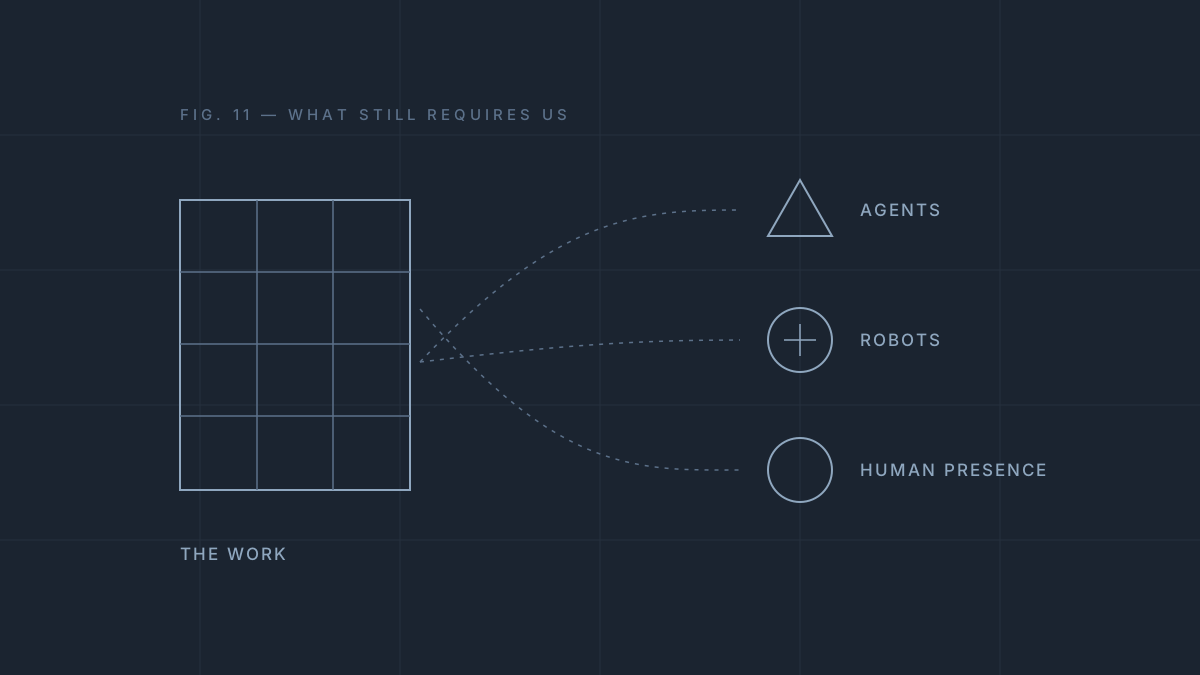
The McKinsey Global Institute’s July 2026 report maps the technical automation potential of existing AI agents and robotics across Latin American economies. More than half of current work hours could, in principle, be performed by these systems. AI-driven agents account for the larger portion of that potential. Robots claim a comparatively greater share than they do in advanced economies because physical tasks—agriculture, manufacturing, logistics, construction, and elements of care—still constitute a larger fraction of the region’s labor.
These figures represent technical feasibility, not forecasts of adoption or displacement. The report notes that automation could unlock roughly $450 billion in annual economic value by 2030, with Mexico showing the highest potential at approximately 59 percent of work hours and $204 billion in value. The central observation is quieter: most skills will still be needed, but the way people apply them will change as they work alongside intelligent machines.
Pattern
This belongs to a longer sequence in which successive technologies have redrawn the boundary between tasks that can be executed with limited ongoing human attention and tasks that continue to require it. Earlier waves of mechanization and computing absorbed repetitive physical and clerical work. The current wave extends that absorption into cognitive coordination, pattern recognition, and certain forms of physical manipulation.
What distinguishes the present moment is the simultaneous expansion into both domains—agents handling sequencing and judgment within defined parameters, robots handling load and repetition in structured environments. Latin America’s task composition makes the robot component more salient than in economies where service and knowledge work already dominate. The pattern is not replacement of entire occupations but recomposition of activities within them, with the rate and distribution of change governed by economics, infrastructure, skills, and institutional choices rather than technical possibility alone.
Implication
What becomes newly possible is the reallocation of human effort away from the most physically taxing and cognitively repetitive components of existing roles. In care settings, agents can surface patterns in vital signs or medication adherence while robots assist with lifting and positioning; the remaining human work centers on presence, contextual judgment, and the relational acts that cannot be delegated without loss of meaning. Similar recompositions appear in agriculture, small-scale manufacturing, and education.
What becomes more visible is the structural importance of capacities that remain difficult to automate at scale: the ability to respond to novelty, to exercise ethical or relational judgment under uncertainty, and to maintain continuity of care or attention across time. These capacities do not shrink in significance as automation potential grows; in many domains they become the residual core around which other activities are organized.
Second-order effects follow from the uneven distribution of adoption. Sectors and workers already positioned to integrate new tools will capture productivity gains. Those in highly automatable activities without clear transition paths, particularly within the large informal sector, face greater friction. Training systems that remain oriented toward static occupational categories will lag behind the actual recomposition of tasks. Demographic variation across the region—younger populations in some countries, rapid aging in others—will amplify or dampen these pressures depending on whether reskilling infrastructure reaches the relevant populations.
Undersong
Beneath the measured potential for agents and robots lies a simpler observation: the work that most requires continuous human presence—care, cultivation, and the exercise of judgment when rules are incomplete—does not become marginal simply because machines can now perform more of what surrounds it. That presence remains the element that holds the rest together.
Core Pattern Technology repeatedly expands the domain of work that can proceed with reduced continuous human attention, yet the subset of activities that still require sustained human attention—particularly those involving care, novelty, and relational or ethical judgment—retains structural centrality and often increases in relative value.
What This Alters It alters which parts of work we continue to treat as peripheral and which we recognize as indispensable. The tasks machines can reach become candidates for delegation; the tasks that still require people become more visibly the site where quality, meaning, and social cohesion are determined.
Resonant Line “Most skills will still be needed—but how people use them will change as they work alongside intelligent machines.”
Passages for Transmission
- The figures represent technical feasibility, not forecasts of adoption or displacement.
- Most skills will still be needed, but the way people apply them will change as they work alongside intelligent machines.
- The work that most requires continuous human presence does not become marginal simply because machines can now perform more of what surrounds it.
Source McKinsey Global Institute, “Agents, robots, and us: How AI reshapes work and skills in Latin America,” July 9, 2026. https://www.mckinsey.com/mgi/our-research/agents-robots-and-us-how-ai-reshapes-work-and-skills-in-latin-america