
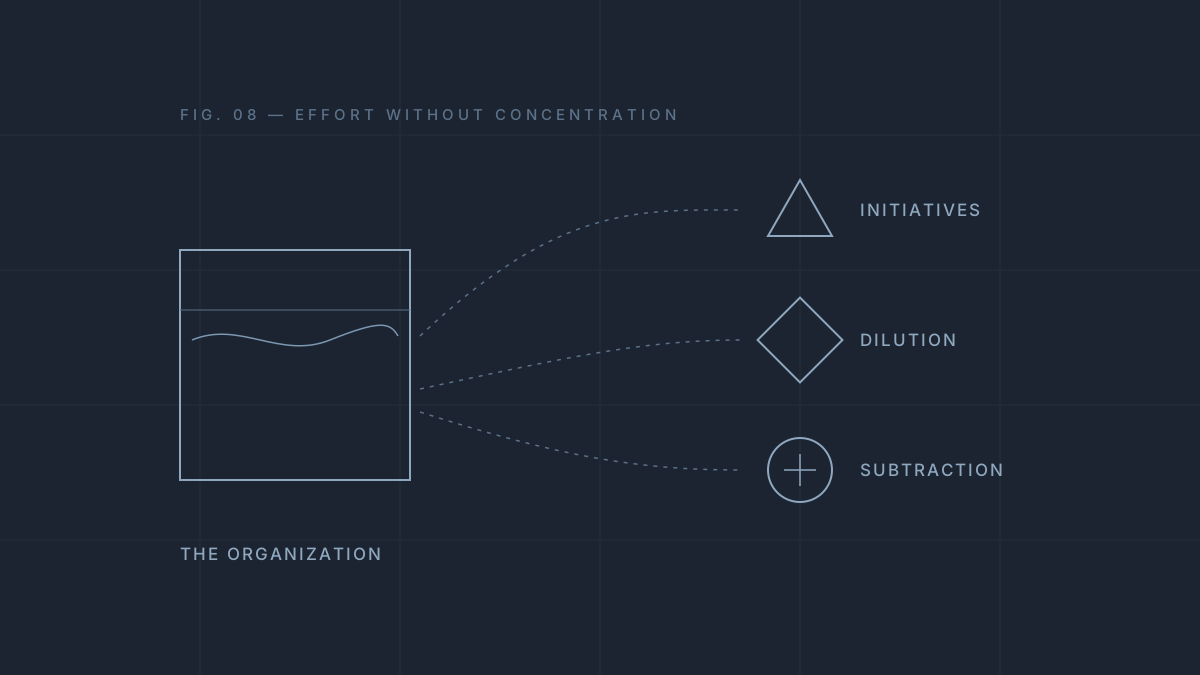
In late 2006, Brad Garlinghouse, then a senior vice president at Yahoo, circulated an internal memo that would later become known as the “Peanut Butter Manifesto.” His central charge was that Yahoo was spreading its people, money, and attention across too many products and initiatives in roughly equal measure. The result, he argued, was that nothing received the concentrated effort required to achieve real excellence or scale. The company was busy, but it was not focused.
This pattern appears in many organizations once they reach a certain size and complexity. New opportunities, legacy products, internal stakeholder demands, and the natural desire to avoid conflict all push toward adding more priorities rather than ruthlessly reducing them. What feels like prudent breadth or “covering the bases” often functions as a way to defer difficult decisions about where the organization’s real advantage lies. Resources become diluted, accountability becomes diffuse, and the organization slowly loses the ability to move decisively in any single direction.
What changes when this pattern is recognized is the understanding that focus is not primarily an additive activity. It is a subtractive one. Choosing to do something well usually requires choosing not to do several other things at all, or at least not at the same level of investment. When an organization treats most initiatives as roughly equal in importance, it rarely admits that it is making a de facto decision to underfund nearly everything. The peanut butter approach preserves the feeling of strategic breadth while quietly eroding the conditions under which any single effort can succeed at scale.
This does not mean organizations should only pursue one thing. It means they must be willing to make some bets meaningfully larger than others and to accept the consequences of that asymmetry. The cost of avoiding those choices is rarely dramatic in any single quarter. It compounds over time as talent migrates toward clearer opportunities elsewhere, as promising efforts fail to reach critical mass, and as the organization becomes known more for its activity than for its results.
The quieter rule is that strategic clarity is usually achieved through disciplined subtraction rather than through the accumulation of priorities. The organizations that maintain focus over time are rarely the ones that have learned to say yes more effectively. They are the ones that have developed the organizational courage and mechanisms to say no, even to good ideas, so that a smaller number of efforts can receive the resources and attention required to matter.
Core Pattern Large organizations under complexity pressure tend to convert strategy into a broad portfolio of initiatives rather than a concentrated set of priorities, because adding priorities feels safer and less conflictual than removing them.
What This Alters It reveals that the appearance of balanced effort often functions as a substitute for making hard choices about where real advantage can be built, and that this substitution carries compounding costs in focus, talent, and results.
Resonant Line Spreading resources evenly across many initiatives preserves the feeling of strategic activity while quietly preventing any single effort from reaching the threshold where it can succeed.
Passages for Transmission
- Focus is not primarily an additive activity. It is a subtractive one.
- The appearance of balanced effort often functions as a substitute for making hard choices about where real advantage can be built.
- Strategic clarity is usually achieved through disciplined subtraction rather than through the accumulation of priorities.
Source: “Yahoo Memo: The ‘Peanut Butter Manifesto’” by Brad Garlinghouse, The Wall Street Journal, November 18, 2006.