We built the modern world by turning verbs into nouns.
Health became a number.
Intelligence became a score.
Food became a commodity.
Soil became acreage.
Work became a job.
Nature became a place we visit after leaving the office.
This conversion made the world easier to measure.
It also made it easier to misunderstand.
Relationships in Motion
In a recent conversation with Joe Rogan, physician and regenerative-agriculture advocate Zach Bush returns repeatedly to a deceptively simple distinction: living systems are not collections of fixed objects. They are relationships in motion.
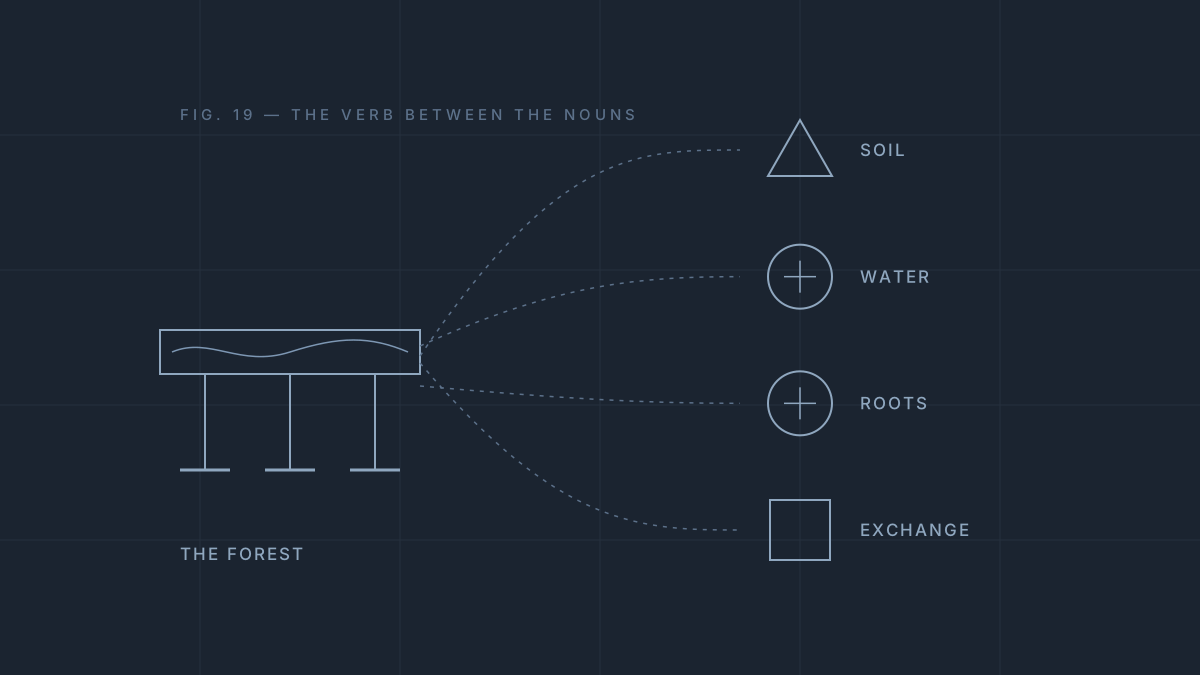
A forest is not merely trees.
A body is not merely organs.
A community is not merely residents.
A farm is not merely land, equipment, and yield.
These are temporary forms produced by continuous exchange.
Water moving.
Microbes negotiating.
Cells signaling.
Roots trading.
People teaching, feeding, repairing, remembering, and belonging.
The visible structure is only the current shape of the conversation.
Reduction Is an Instrument
Modern science has gained extraordinary power by isolating variables.
Separate the molecule.
Control the environment.
Name the mechanism.
Measure the outcome.
This method is useful precisely because it removes context.
But life works precisely because context is never removed.
A cell behaves differently depending on the tissue around it.
A person behaves differently depending on the community around them.
A crop behaves differently depending on the soil beneath it.
The thing cannot be fully understood apart from the relationships that make the thing possible.
Reduction is an instrument.
The mistake is believing it reveals the whole.
The Error Across Institutions
We have made the same error across nearly every institution.
Healthcare divides the person into specialties.
Agriculture divides the ecosystem into inputs and outputs.
Education divides knowledge into subjects.
Business divides work into departments.
Government divides communities into programs.
Technology divides behavior into data points.
Each division creates administrative clarity.
Each one also cuts across relationships that do not recognize the boundary.
The body does not know which specialist owns the symptom.
The watershed does not know where the county line ends.
The family does not experience housing, transportation, food, employment, and health as separate programs.
Reality remains integrated even when the organization chart does not.
More Information, Less Coherence
This may explain why so many technically sophisticated systems feel increasingly incapable of producing wholeness.
We have more information and less coherence.
More specialists and fewer translators.
More platforms and weaker connective tissue.
More interventions and less understanding of what the intervention interrupts.
The institutions are optimized around nouns.
Life keeps arriving as a verb.
When the Model Replaces the World
Bush uses the language of biology and ecology to challenge this static worldview. Some of the episode's specific health assertions — particularly those concerning glyphosate, obesity, autism, fertility, and chronic disease — are sweeping, disputed, and should not be accepted merely because they fit an elegant systems narrative.
But beneath those claims is a question worth carrying forward:
What happens when the tools designed to study life begin replacing our experience of life?
The laboratory marker becomes the patient.
The diagnosis becomes the person.
The productivity metric becomes the employee.
The economic output becomes the community.
The model becomes the world.
Symbols are necessary.
They allow us to communicate, coordinate, and decide.
But a symbol is not the thing it represents.
A map can guide us through the forest.
It cannot breathe for the forest.
Where the Separation Begins
Language may be where the separation begins.
A noun gives the impression that something exists independently.
A tree.
A river.
A body.
A self.
But look closely and the independence disappears.
The tree is sunlight becoming cellulose through soil, water, fungi, atmosphere, and time.
The river is rainfall, gravity, stone, sediment, fish, plants, floodplain, and ocean continuously becoming one another.
The body is food, microbes, memory, ancestry, environment, stress, sleep, affection, movement, and breath temporarily held in human form.
Even the self is not static.
We are continually assembled by what passes through us.
Perhaps a tree is not a thing.
It is treeing.
A river is rivering.
A body is bodying.
A community is commoning.
Life is not stored inside the nouns.
It happens between them.
AI Makes the Distinction Urgent
Artificial intelligence makes this distinction more urgent.
AI is exceptionally good at manipulating symbols.
It can compare representations, detect patterns, predict likely sequences, and generate convincing maps of nearly any territory.
As this capacity expands, the temptation will be to treat representation as reality more often, not less.
The generated plan will resemble understanding.
The digital twin will resemble the place.
The health score will resemble health.
The simulation will resemble experience.
The answer will resemble wisdom.
This does not make the technology empty.
It makes context more valuable.
The more powerful our symbolic systems become, the more important it is to preserve contact with what cannot be fully represented.
Presence.
Judgment.
Embodiment.
Relationship.
Consequences experienced in an actual place.
Recovering Our Ability to Participate in Verbs
The future of human work may depend less on competing with machines at processing nouns and more on recovering our ability to participate in verbs.
Not merely identifying what something is.
Helping it become.
Growing.
Healing.
Teaching.
Stewarding.
Reconciling.
Building.
Caring.
These activities resist clean abstraction because their meaning emerges from relationship.
A caregiver does not simply complete tasks around a resident.
They notice.
A teacher does not simply transfer information.
They awaken.
A farmer does not manufacture a crop.
They participate in conditions from which a crop may emerge.
The most important work has always involved entering a living system without pretending to control it completely.
The Questions Determine What the System Notices
Regeneration begins when we stop asking only how much a system can produce and start asking what relationships allow it to remain alive.
Not: How much can this soil yield? But: What does the soil need to keep becoming soil?
Not: How many patients can this clinic process? But: What allows this community to keep becoming healthier?
Not: How much output can this employee generate? But: What allows a human being to keep becoming more capable, connected, and alive?
The change appears linguistic.
It is actually structural.
The questions determine what the system is built to notice.
Undersong
Perhaps the crisis beneath our many visible crises is not simply technological, ecological, economic, or medical.
It is grammatical.
We keep treating processes as possessions.
Relationships as resources.
Living beings as stable objects that can be optimized independently of everything surrounding them.
But nothing living exists independently.
That is not a poetic metaphor.
It is the operating condition.
The forest is not the trees.
The body is not the parts.
The intelligence is not the brain.
The community is not the buildings.
The power was never located inside the objects.
It moves through the relationships.
Life is not a noun.
It is what the nouns are doing together.
Core Pattern Naming a living system as a fixed object obscures that it is a set of relationships in continuous motion; every institution that divides reality for administrative clarity cuts across relationships that do not recognize the boundary.
What This Alters It reframes the deepest problems as grammatical rather than merely technical — and, as AI grows fluent with symbols, relocates human value toward the verbs (presence, judgment, stewardship, care) that resist representation.
Resonant Line Life is not stored inside the nouns. It happens between them.
Passages for Transmission
- We have more information and less coherence; more platforms and weaker connective tissue.
- A map can guide us through the forest. It cannot breathe for the forest.
- The power was never located inside the objects. It moves through the relationships.
Source The Joe Rogan Experience — in conversation with Zach Bush, MD. The episode's specific health claims are disputed and are not endorsed here; this piece carries forward the underlying systems argument, not the contested assertions.