
We want our food to do more than feed us.
We want it to explain us. We want the loaf to carry a theology, the lentil to become a prescription, the fish to bear the signature of God. A food described as biblical seems to arrive with an authority that ordinary nutrition advice cannot quite match.
This is part of the appeal behind videos promising "biblical protein bombs" — ancient foods that can rebuild muscle, restore strength, and return the body to a forgotten natural order.
There is something valuable in that instinct. Lentils, beans, whole grains, nuts, seeds, fish, eggs, dairy, and meat can all contribute meaningfully to a nourishing diet. Modern nutrition recognizes protein as essential to building and repairing the tissues of the body.
But protein is a modern biochemical category.
It is not the category through which the biblical authors understood food.
When Scripture speaks about bread, lentils, oil, milk, meat, fish, or wine, it is rarely trying to answer the question now printed on the side of a package:
How many grams does this contain?
The biblical questions are different:
Who provided this food?
Who labored for it?
Who controls the land from which it came?
Who is permitted to eat?
Who remains hungry outside the gate?
And what happens to human beings when abundance causes them to forget that they were once dependent?
To read biblical food well, then, we must look beyond the ingredients. We must recover the world in which those ingredients were grown, rationed, sacrificed, shared, withheld, and received.
There Was No Single "Biblical Diet"
The Bible spans centuries of agricultural, political, and cultural change. Its foodways emerge from pastoral camps, village farms, royal courts, fishing communities, military sieges, imperial banquets, temple sacrifices, wedding feasts, and periods of famine.
There was no single meal plan followed uniformly from Abraham to Paul.
Food varied by region, season, wealth, occupation, and historical period. Archaeological and textual evidence nevertheless reveals a broadly Mediterranean food environment built around grains, legumes, olives, fruit, vegetables, and — in varying quantities — fish, dairy, and meat.
The center of this world was not meat.
It was bread.
The Hebrew word leḥem ordinarily means bread, but it can also stand more broadly for food or a meal. To "eat bread" with someone was not merely to consume a carbohydrate. It was to share a table, establish fellowship, and participate in a relationship. Bread was so fundamental that it became almost synonymous with sustenance itself.
This helps explain why biblical language so often treats bread as something larger than nutrition.
Bread is daily dependence.
Bread is hospitality.
Bread is wages.
Bread is vulnerability.
Bread is what can be broken, multiplied, withheld, or shared.
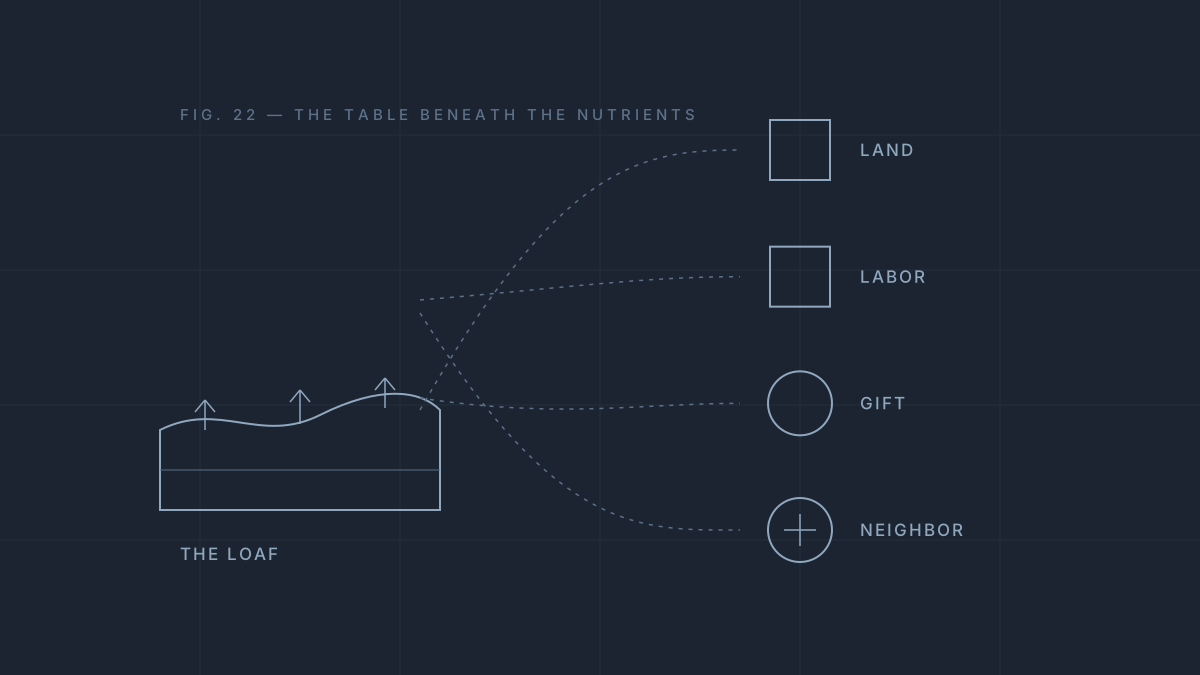
Long before anyone counted protein, the loaf already carried an entire social world.
The Lentils That Did Not Save Esau
Lentils appear most famously in Genesis 25.
Esau returns from the field exhausted and encounters Jacob preparing a stew. He asks for the red food, and Jacob demands Esau's birthright in exchange. The text identifies the meal simply: bread and lentil stew.
Esau eats.
He drinks.
He rises.
He leaves.
Then the narrator delivers the judgment: Esau despised his birthright.
A modern nutritional reading can easily lift the lentils from the story and announce them as an ancient source of plant protein. That statement may be nutritionally correct, but exegetically it misses nearly everything.
Genesis is not recommending Jacob's recipe.
The lentils function within a story about appetite, inheritance, impatience, and the human tendency to exchange what is enduring for what is immediately available.
Esau's problem is not that he chooses the wrong food.
His problem is that hunger has collapsed his horizon.
He can no longer perceive value beyond the present moment.
The lentil stew is therefore not primarily a wellness symbol. It is the substance through which character is revealed. A nourishing food becomes the occasion for a ruinous transaction.
This is one of the Bible's recurring insights: food may strengthen the body while exposing the soul.
Ezekiel Bread Was a Sign of Catastrophe
Few biblical foods have been commercialized more successfully than "Ezekiel bread."
The name comes from Ezekiel 4:9, where the prophet is instructed to combine wheat, barley, beans, lentils, millet, and emmer into bread. From a contemporary perspective, the mixture sounds impressively nutrient-dense — a combination of grains and legumes that can contribute fiber, minerals, and complementary amino acids.
But the passage is not a recipe given in a garden.
It is a siege prophecy.
Ezekiel is told to eat the bread in carefully rationed portions and drink water by measured amounts. The severe restriction represents the scarcity that will accompany Jerusalem's collapse. Even the fuel used to bake the bread becomes a symbol of degradation and ritual distress.
The ingredients modern readers celebrate as a superfood were mixed together because ordinary distinctions were disappearing under conditions of desperation. The people would gather whatever remained and stretch it as far as possible.
Ezekiel's bread is survival food.
It represents the breakdown of a society.
That does not mean a modern sprouted-grain loaf is unhealthy. It means the biblical passage cannot be understood merely by studying its ingredient list.
Removed from context, a prophetic sign of siege becomes a lifestyle product.
The reversal is almost perfect.
Daniel's Diet Was an Act of Resistance
Daniel 1 is another passage frequently converted into a nutritional program.
Daniel and his companions, taken into Babylonian service, decline the king's food and wine. They request instead what the Hebrew text calls zērōʿîm or zērʿōnîm — a term connected with seeds or things sown — and water.
Translations have rendered the word variously as vegetables, legumes, pulse, or food grown from seed. Its precise menu is less certain than many modern "Daniel diets" imply.
The larger setting matters more.
Daniel is living inside an imperial program of assimilation. He has been removed from Jerusalem, educated in Babylonian literature, assigned a Babylonian name, and prepared for service to the king.
The royal food is part of that environment.
Whatever the exact reason Daniel considers it defiling — ritual concerns, its association with the royal table, imperial dependence, or some combination — the dietary choice marks a boundary. It is a disciplined refusal to allow the empire to become the final source of his identity.
Daniel is not conducting an ancient protein trial.
He is negotiating faithfulness under pressure.
The point is not that vegetables possess secret spiritual power. The point is that something as ordinary as eating can become a practice of remembrance.
Empire says: Your life comes from this table.
Daniel answers: Not entirely.
The Seven Species and the Danger of Being Full
Deuteronomy describes the promised land through seven characteristic foods: wheat, barley, grapes, figs, pomegranates, olive oil, and honey — probably including the thick sweetness produced from dates.
Together they evoke fertility, stability, beauty, cultivation, and abundance.
Yet Deuteronomy's concern is not simply that Israel will enter the land and finally eat well.
Its deeper concern is what will happen after they have eaten and are satisfied.
Fullness creates its own spiritual danger.
Once houses have been built, fields have produced, herds have multiplied, and wealth has accumulated, the people may say that their own strength created their prosperity. The abundance that was meant to produce gratitude may instead generate amnesia.
This is why biblical food theology cannot be reduced to identifying healthy ingredients.
The central problem is not always hunger.
Sometimes the central problem is satiety without memory.
The Bible repeatedly asks whether abundance will remain gift or become possession; whether it will produce generosity or self-congratulation; whether the full will remember the hungry.
A truly biblical approach to nutrition would therefore have to ask more than whether the food rebuilds my body.
It would also ask:
Who grew it?
Were they paid fairly?
What happened to the soil?
Who has access to this quality of food?
What responsibility accompanies my abundance?
A food does not become biblical merely because it was cultivated in the ancient Near East.
Its biblical character is revealed in the relationships surrounding it.
What Can Be Recovered
None of this requires us to dismiss the practical intuition behind the video.
There is wisdom in returning attention to minimally processed foods: beans and lentils, intact grains, nuts and seeds, vegetables, fruit, olive oil, fish, eggs, and other nutrient-dense sources of protein.
This pattern has substantial overlap with what is now called the Mediterranean diet — not because the Bible secretly contained a modern nutritional protocol, but because both emerge, in part, from the agricultural ecology of the Mediterranean world. Contemporary research generally describes this pattern as plant-forward, rich in legumes, whole grains, nuts, vegetables, fruit, and olive oil, with more moderate use of fish, dairy, and meat.
For rebuilding and preserving muscle, food also cannot be separated from movement. Adequate protein can support tissue maintenance and repair, but resistance exercise supplies the body with the signal to adapt. Research on healthy aging therefore commonly treats protein intake and physical activity as complementary rather than competing strategies.
The ancient foods may help.
But there is no single lentil, seed, fish, or grain capable of doing the work alone.
Bodies are rebuilt through patterns:
food eaten consistently,
muscles used repeatedly,
sleep received adequately,
stress carried differently,
and meals shared rather than merely optimized.
This may be where the ancient world still speaks most clearly.
Most biblical food was not eaten from a wrapper, in a car, or alone in front of a screen. It arrived inside a network of land, weather, labor, family, hospitality, festival, grief, and gratitude.
Food did not merely enter the body.
It located the body inside a community.
Undersong
Perhaps the deepest biblical correction to contemporary wellness culture is that the body is never entirely a private project.
Modern health language encourages us to treat the body as an individual possession to be managed, improved, monitored, and optimized. Scripture more often presents the body as a creaturely life sustained by gifts it did not manufacture.
Rain falls.
Seed germinates.
Animals feed.
Farmers labor.
Bread rises.
Someone sets the table.
Someone else is invited.
This does not make nutrition less important. It makes nutrition more relational.
The Bible's lentils, grains, fish, oils, seeds, and animal foods can indeed contribute to strong bodies. But their deeper testimony is not that God hid a collection of biochemical shortcuts inside Scripture.
Their testimony is that life is received through dependence.
The biblical table does not ask only:
How much protein is here?
It also asks:
Who gave this bread?
What will this strength be used for?
Who has not yet been invited?
And what might our fullness cause us to forget?
The goal is not to make ancient food fashionable.
It is to recover the form of attention the food once required.
To eat with gratitude.
To grow strong without imagining ourselves self-made.
To receive abundance without allowing abundance to erase memory.
To understand that the body is rebuilt not only by what it consumes, but by the relationships, practices, and purposes into which that renewed strength is given.
We do not live by protein alone.
We live by gift, memory, labor, restraint, movement, and the shared bread through which strangers slowly become neighbors.
Core Pattern Reading a situated, relational practice through a single modern metric (protein) performs a category error that strips away everything the practice was actually about — provision, labor, land, restraint, memory, and who is fed.
What This Alters It reframes nutrition from a private optimization problem into a relational one: a truly ancient reading asks not only whether food rebuilds my body, but who grew it, who is invited, and what my fullness might cause me to forget.
Resonant Line Food did not merely enter the body. It located the body inside a community.
Passages for Transmission
- Long before anyone counted protein, the loaf already carried an entire social world.
- Removed from context, a prophetic sign of siege becomes a lifestyle product.
- We do not live by protein alone. We live by gift, memory, labor, restraint, movement, and the shared bread through which strangers slowly become neighbors.