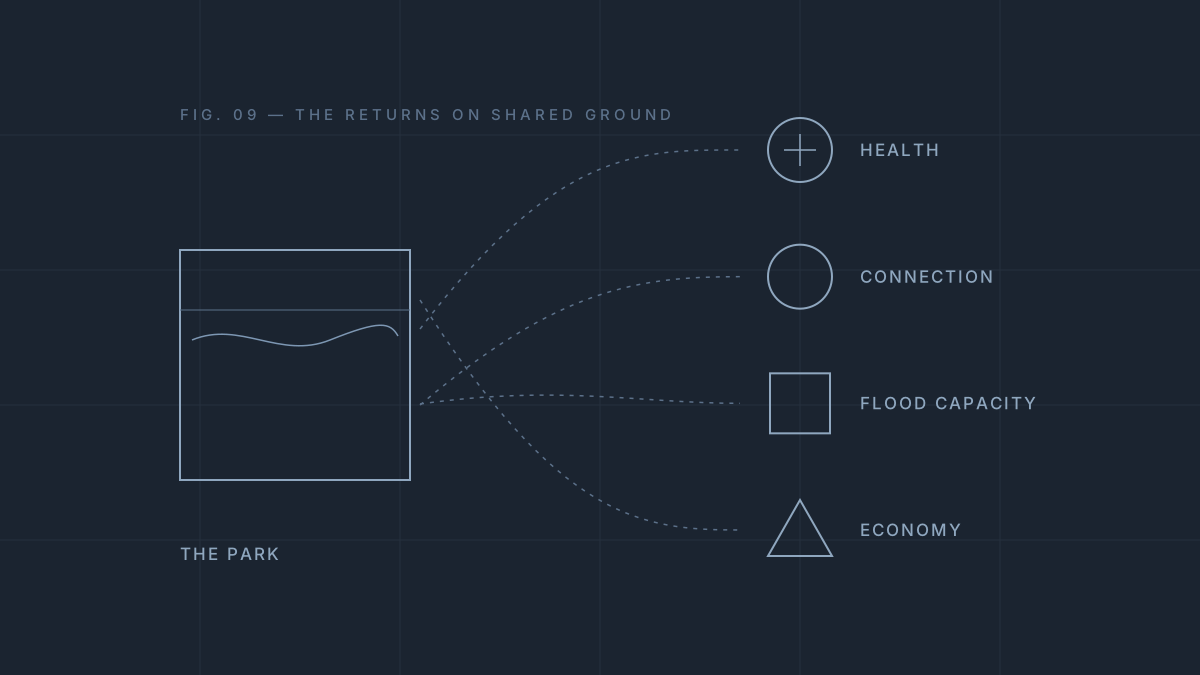
A recent analysis from the Trust for Public Land makes a straightforward case: communities receive roughly three dollars in measurable local benefits for every dollar invested in parks and recreation. These returns appear across economic activity, reduced healthcare costs from physical inactivity, improved mental well-being, and lower flood-related damages. The Florida Gulf Coast Trail, a 420-mile greenway in development, is cited as one example projected to generate substantial tourism and recreation spending in counties like Sarasota while also providing connected open space.
This argument sits inside a broader pattern. Across much of the United States, and particularly in fast-growing, climate-exposed areas, parks and trails have historically been planned and funded as amenities rather than as core infrastructure. Roads, utilities, and emergency services receive consistent capital planning and dedicated revenue streams. Green space, by contrast, often competes for discretionary dollars and is among the first categories to face cuts or delays. The result is a landscape in which the very features that support daily physical activity, social connection, and stormwater absorption remain underprovided relative to their documented contributions.
What shifts when parks are viewed as infrastructure is the frame for evaluating their absence. Physical inactivity already carries large societal costs in chronic disease. Loneliness has been recognized as a public health concern with measurable effects on older adults and others with limited mobility. In places like Florida’s Gulf Coast, where storms are intensifying and conventional drainage systems are frequently overwhelmed, parks and green corridors also perform flood mitigation functions that reduce property damage and emergency response burdens. When these spaces are missing or poorly distributed, the costs do not disappear; they reappear in healthcare spending, lost economic activity, and higher long-term adaptation expenses.
This does not require romanticizing parks or claiming they solve every problem. It does require recognizing that accessible, well-maintained shared green space produces compounding returns across domains that are usually budgeted and planned separately. In communities where housing is expensive and private outdoor space is limited, these public assets become particularly important for daily movement and social interaction. In regions facing both demographic aging and increasing climate volatility, the same spaces contribute to both health maintenance and physical resilience.
The quieter rule is that shared public space supporting physical movement, mental well-being, and social connection functions as quiet but high-leverage infrastructure, especially where isolation and climate stress are increasing. The decision to treat such space as optional or secondary is rarely defended on the grounds that its benefits are small. It is more often the product of planning systems and funding structures that were never designed to account for those benefits in the first place.
Core Pattern In conventional infrastructure and land-use planning, accessible green and recreational space is consistently undervalued relative to its documented contributions to health, economic activity, and climate adaptation.
What This Alters It reframes the absence or underinvestment in parks not as a neutral budgetary choice but as a decision that carries measurable downstream costs in healthcare, social cohesion, and flood resilience — costs that are rarely tracked in the same ledgers as the initial savings.
Resonant Line The spaces that most reliably support daily health and long-term resilience are often the ones treated as the most discretionary.
Passages for Transmission
- Parks and green corridors perform flood mitigation functions that reduce property damage and emergency response burdens.
- When these spaces are missing or poorly distributed, the costs do not disappear; they reappear in healthcare spending, lost economic activity, and higher long-term adaptation expenses.
- Shared public space supporting physical movement, mental well-being, and social connection functions as quiet but high-leverage infrastructure.
Source: “Your local park is bringing in the green (and by that, we mean money)” by Matt Simon (via Grist), The Invading Sea, June 22, 2026.