There is a familiar image of innovation.
A laboratory.
A patent.
A demonstration.
A launch.
But some technologies become real somewhere quieter.
On a farm.
At a summer camp.
Beside a barn.
In a place where the system is asked to work every day, without ceremony, for people who simply need water.
A Tennessee Lookout article tells the story of Florida-based Altitude Water and an atmospheric water-generation system tested at Amy Grant’s Hidden Trace Farm in Williamson County, Tennessee. The relationship began in 2014, when the farm needed drinking water for a youth camp. Years later, the same underlying technology was incorporated into a mobile disaster-relief trailer and deployed after Hurricane Helene to communities in Florida and North Carolina that had lost water, electricity, and communications.
The visible story is about pulling drinking water from air.
The quieter story is about how resilience is actually built.
Not at the moment of crisis.
Before it.
A prototype becomes infrastructure slowly
We often imagine disaster technology as something designed specifically for emergencies.
A rescue vehicle.
A field hospital.
A communications trailer.
A mobile generator.
But the most dependable emergency systems are usually not born in emergency conditions.
They are tested through repetition.
They fail in smaller ways first.
They are adjusted by people who have time to notice what does not work.
They accumulate operators, routines, spare parts, and confidence.
The farm mattered not because it resembled a disaster zone.
It mattered because it provided a real operating environment.
There were people to serve.
There was weather.
There was maintenance.
There were ordinary demands placed on the equipment over time.
This is the part of innovation that receives less attention.
The technology did not move directly from invention to rescue.
It passed through usefulness.
The farm was not a backdrop
The presence of a well-known musician makes the story memorable.
But the deeper significance of the farm is not celebrity.
It is context.
A rural property with a youth camp needed a dependable source of drinking water. That is a practical constraint, not a demonstration script.
A system installed there had to become part of daily life.
It had to operate outside the controlled conditions of a showroom.
It had to coexist with the routines of the place.
It had to produce something people would actually drink.
This is what living laboratories do well.
They expose technology to the unevenness of reality before the stakes become extreme.
A farm, school, senior living community, rural clinic, church campus, or community center can become more than a customer for a new system.
It can become a place where resilience infrastructure is rehearsed.
The distinction matters.
A product is purchased.
A capability is cultivated.
Water is usually invisible until it is interrupted
Modern water systems are designed to disappear.
Turn the handle.
Fill the glass.
Flush the line.
The system is most successful when the user never has to think about the source, treatment plant, pumping station, storage tank, electrical supply, or miles of pipe beneath the street.
This invisibility creates trust.
It also creates fragility in how we think.
We experience water as a fixture rather than a network of dependencies.
When a hurricane damages power systems, contaminates local supplies, breaks distribution lines, blocks roads, or isolates communities, the faucet reveals the infrastructure behind it.
The interruption is not merely a lack of water.
It is the failure of several systems at once.
That is why a technology capable of producing water near the point of need is compelling. Atmospheric water generation can create potable water from surrounding air and has been studied as a possible emergency or supplemental source when ordinary water services are disrupted by disasters, contamination, or infrastructure failure.
It does not repair the municipal system.
It creates a temporary layer beneath it.
Resilience is not the same as replacement
There is a tendency to describe new infrastructure technologies in total terms.
Water from air will replace pipes.
Microgrids will replace the grid.
Telehealth will replace the clinic.
Remote work will replace the office.
AI will replace the worker.
Reality is usually more layered.
Atmospheric water generation is not likely to replace large municipal water systems in most places. Its production depends on ambient temperature and humidity, and active systems can require substantial energy. Research has found that water output and efficiency vary considerably with environmental conditions, while lifecycle impacts are strongly influenced by the electricity required to operate the equipment.
That limitation does not make the technology unimportant.
It clarifies its role.
The strongest use case may not be universal replacement.
It may be continuity.
A bridge between system failure and system restoration.
A source for drinking and essential functions when the ordinary network is unavailable.
A mobile capability for shelters, clinics, camps, rural communities, and disaster-response teams.
A supplement that reduces dependence on trucked bottled water.
A backup that becomes valuable precisely because it does not need to meet every need.
Resilience often comes from partial systems that keep the most important functions alive.
The last mile is also the first failure
Disaster response is filled with logistics.
Water may exist in a warehouse and still be unavailable to the person who needs it.
Roads may be blocked.
Fuel may be scarce.
Storage may be limited.
Distribution points may not be accessible.
Communications may be down.
The challenge is not only producing or purchasing supplies.
It is moving them through a damaged environment.
Bottled water solves one problem by creating several others.
It must be manufactured, packaged, stored, transported, unloaded, distributed, and eventually discarded. Each step depends on vehicles, labor, roads, fuel, coordination, and time.
A mobile system that produces water from local atmospheric moisture changes the logistics.
It does not eliminate logistics.
The machine still requires transport, power, maintenance, filters, storage, trained operators, and suitable environmental conditions.
But the cargo is different.
Instead of repeatedly transporting the finished water, the response system transports the capacity to produce it.
That is a fundamental change.
It moves relief from delivery toward local production.
The trailer is a compressed utility
The disaster-relief trailer described by Altitude Water was deployed after Hurricane Helene to communities that had simultaneously lost clean water, power, and communications. The company describes the trailer as part of a broader effort to provide mobile atmospheric water generation during emergencies.
A trailer like this is more than equipment on wheels.
It is a compressed utility.
Generation.
Treatment.
Storage.
Distribution.
Power.
Mobility.
In a permanent system, these functions are dispersed across a landscape.
In a mobile system, they are condensed into something that can be repositioned.
This compression is becoming a recurring pattern in resilience technology.
Solar microgrids are placed on trailers.
Clinics are fitted into vans.
Communications systems travel in cases.
Battery storage arrives by truck.
Water treatment is mounted in containers.
Infrastructure is becoming deployable.
The significance is not simply portability.
It is the possibility of restoring a limited but essential service without waiting for the entire regional system to recover.
Distributed systems fail differently
Centralized infrastructure offers scale.
One treatment plant can serve a city.
One grid can balance supply across a region.
One network can create consistency and efficiency.
But scale also concentrates dependency.
When a major node fails, many people can lose access at once.
Distributed systems fail differently.
They may be less efficient under ordinary conditions.
They may require more local maintenance.
They may produce smaller quantities.
But they can create redundancy.
A farm with its own drinking-water capability does not become independent of every outside system.
A community with a mobile water unit does not become immune to disaster.
It gains another path.
Resilience is often nothing more mysterious than preserving multiple paths to the same essential outcome.
Water can arrive through the pipe.
Through stored reserves.
Through purification.
Through delivery.
Or, under the right conditions, through the air.
The value lies partly in the fact that these paths do not all fail for the same reason.
Climate resilience is operational, not rhetorical
The phrase climate resilience is now attached to plans, grants, products, buildings, and public strategies.
It can become abstract.
A quality that an organization claims rather than a capability it can demonstrate.
But resilience is concrete.
How many people can receive safe water?
For how many days?
Under what humidity?
Using what power source?
Who knows how to operate the equipment?
Where are replacement filters stored?
How quickly can the unit be transported?
Can it travel when roads are damaged?
Can it run without grid power?
What happens when the air is cooler or drier than expected?
Which needs receive priority when output is limited?
These questions are less inspiring than the general promise of resilience.
They are also what make the promise real.
A system becomes resilient when the operational details have been worked through before the emergency.
That is why the years on the farm matter.
They represent time spent converting a concept into an operating habit.
The ordinary use may justify the emergency capacity
Emergency equipment presents a financial problem.
Communities may need it urgently but use it rarely.
An asset purchased solely for disaster response can sit idle for years, becoming harder to maintain, fund, and operate.
By the time it is needed, the staff may be gone, the components outdated, or the system untested.
Dual-use infrastructure offers another model.
A water-generation system can serve an ordinary purpose while maintaining emergency value.
It can support a camp.
Supply a remote facility.
Reduce dependence on bottled water.
Provide redundancy for a clinic.
Serve a community event.
Produce drinking water at a resilience hub.
Then, when disaster occurs, the same equipment, knowledge, and operating routines can be redirected.
This is a stronger economic and institutional model than equipment kept behind a door marked emergency use only.
The ordinary work sustains the extraordinary capability.
Resilience hubs should produce, not merely shelter
Communities often identify buildings that will serve as shelters, cooling centers, distribution points, or emergency gathering places.
But a building does not become a resilience hub because it has been named one.
It becomes a resilience hub when it can continue performing essential functions during disruption.
Power.
Water.
Cooling.
Communications.
Food storage.
Medical support.
Device charging.
Reliable information.
A trusted local operator.
Atmospheric water generation could become one component of that larger system, especially in warm, humid regions where production conditions are favorable. It would not remove the need for stored water, municipal restoration, or mobile deliveries.
It would add a productive capability.
This distinction is important.
A conventional emergency site stores resources.
A resilience hub should also be able to generate some of them.
The shift is from warehouse to micro-utility.
Water from air is not free water
The phrase water from air sounds almost elemental.
As though the machine has bypassed infrastructure entirely.
It has not.
Atmospheric water systems exchange one dependency for another.
Less dependence on pipes or water delivery.
More dependence on electricity, mechanical components, air conditions, filtration, and maintenance.
The water may come from the atmosphere.
The capability still comes from a system.
This is not a criticism.
It is an important design truth.
Resilience is not achieved by pretending dependencies have disappeared.
It is achieved by understanding them well enough to diversify them.
A water generator powered only by a damaged electrical grid is less independent than it first appears.
A mobile unit paired with solar generation, batteries, conventional backup power, replacement filters, trained operators, and realistic production assumptions is something different.
The resilience does not reside in the machine alone.
It resides in the arrangement around it.
Small infrastructure can have large strategic value
A mobile atmospheric water system may not produce enough water to meet every need in a large disaster zone.
That is not necessarily the correct test.
In emergencies, value is not distributed evenly across gallons.
The first safe drinking water at a shelter may matter more than the thousandth gallon used for a lower-priority purpose.
A modest supply can protect medication routines.
Support first responders.
Keep a small clinic operating.
Provide drinking water while larger relief systems mobilize.
Serve people cut off from distribution routes.
Prevent an urgent evacuation.
The strategic value of infrastructure is not always proportional to its total output.
Sometimes it lies in preserving one critical function at the moment it would otherwise fail.
This is why supplementary systems deserve more attention than they often receive.
They do not need to replace the whole network.
They need to hold the gap.
Innovation needs patient places
The origin story at Hidden Trace Farm suggests another lesson.
Emerging resilience technologies need places willing to live with them before they are polished.
Not merely demonstration sites.
Patient sites.
Places where equipment can be installed, observed, questioned, repaired, and improved over time.
The host provides more than land.
It provides reality.
For communities, institutions, and property owners, this can become a meaningful role.
A senior living campus can test backup power and passive monitoring.
A farm can test water, food, and energy systems.
A school can test cooling, communications, and shelter capacity.
A community center can test local distribution and public access.
A clinic can test continuity under partial failure.
The goal is not to turn every property into a technology showroom.
It is to create enough living laboratories that promising systems encounter real life before real life becomes an emergency.
The hidden infrastructure is trust
The technology story begins with moisture in the air.
But the system likely could not have developed through hardware alone.
Someone had to allow the equipment onto the farm.
Someone had to believe the problem was worth solving.
Someone had to maintain the relationship across years.
Someone had to move the technology from a local use to a disaster-response configuration.
Someone had to bring it into communities after the storm.
Infrastructure is usually described in physical terms.
Pipes.
Roads.
Wires.
Machines.
But resilience also depends on relational infrastructure.
Trust between inventors and hosts.
Trust between companies and relief organizations.
Trust between community institutions and residents.
Trust that a system has been tested honestly.
Trust that someone will know what to do when it arrives.
A machine can be transported quickly.
Trust usually cannot.
It must already be there.
Preparedness is accumulated ordinary work
The atmospheric water system at Hidden Trace Farm did not become significant because a disaster eventually occurred.
It became significant because the intervening years were not empty.
The technology was used.
Observed.
Refined.
Integrated.
Remembered.
Then, when the emergency arrived, there was something to deploy besides an idea.
This is the deeper pattern.
Resilience is often mistaken for a product that can be purchased once risk becomes visible.
More often, it is the accumulated result of ordinary work performed before anyone is watching.
A maintained generator.
A tested water system.
A practiced evacuation plan.
A known gathering place.
A stocked clinic.
A local relationship.
A piece of equipment that has already failed safely and been repaired.
The emergency does not create the capability.
It reveals whether the capability was built.
Beneath the water line
Atmospheric water generation is not a universal solution to water scarcity or disaster response.
It is dependent on climate, energy, logistics, maintenance, and scale.
But it points toward a useful model.
Distributed.
Deployable.
Productive.
Dual-purpose.
Tested in ordinary life.
Available when larger systems break.
The important innovation may not be that water can be pulled from air.
It may be that essential infrastructure can be made smaller, more local, and more movable without pretending it can replace the systems around it.
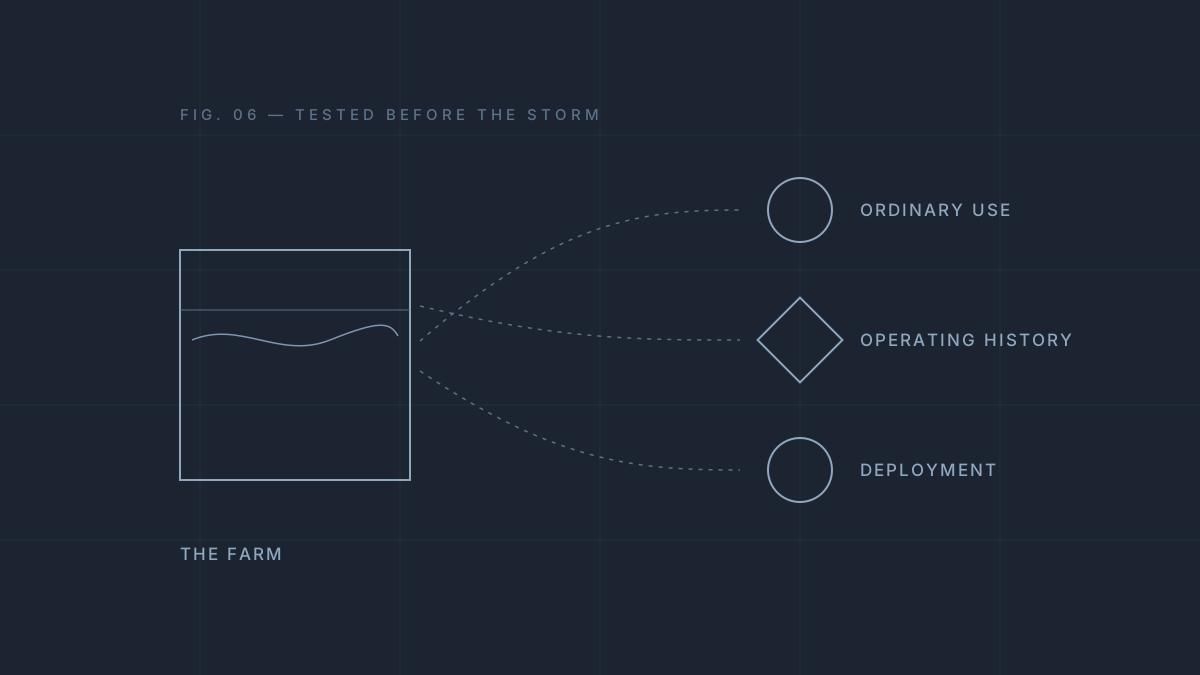
A farm became a test site.
The test site became an operating history.
The operating history became a disaster-relief capability.
That sequence deserves attention.
Because the next generation of resilience infrastructure may not begin with a declaration of emergency.
It may begin somewhere quiet, doing useful work, years before the storm arrives.
Source Note
This piece responds to Cassandra Stephenson’s Tennessee Lookout article, Drinking Water Tech Tested on Amy Grant’s Farm Now Used for Disaster Relief, Climate Resilience, published September 2, 2025. The article traces how atmospheric water-generation technology used at Amy Grant’s Hidden Trace Farm in Tennessee later became part of a mobile disaster-relief system deployed after Hurricane Helene.