The quietest revolutions often begin in the blood.
For decades, the story of Alzheimer's was one of late arrival and limited options. By the time memory faltered or daily life frayed, the underlying processes had been running for ten, fifteen, sometimes twenty years. PET scans and spinal taps could eventually confirm pathology, but they arrived too late for prevention and too invasively for routine use. Most people never got tested until the damage was already speaking in symptoms.
Now a different signal is possible.
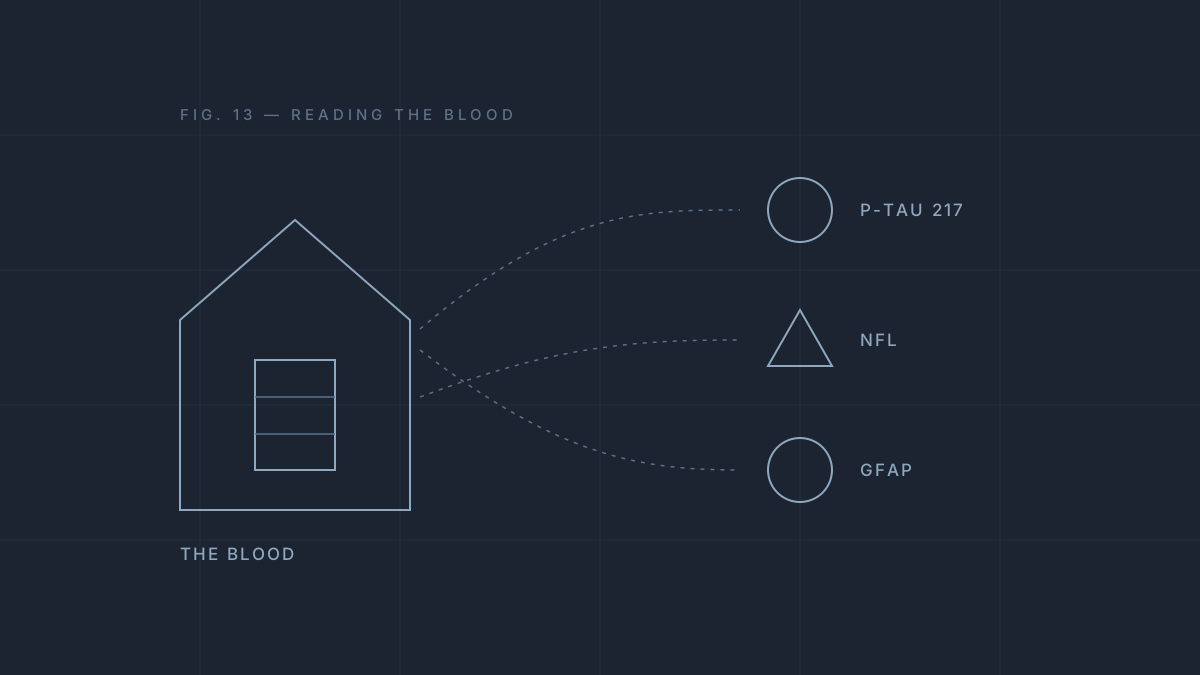
BrainScan — a blood panel offered through Apollo Health in partnership with Neurocode — measures three biomarkers that together paint an early picture of brain health: p-Tau 217 (highly specific for Alzheimer-related processes), NfL (neurofilament light chain, reflecting ongoing neuronal damage), and GFAP (glial fibrillary acidic protein, a marker of brain inflammation and repair). The p-Tau 217 component, using advanced sensitive assay technology, stands out for its ability to detect changes years before cognitive symptoms emerge, with performance approaching that of more invasive gold-standard tests.
This is not a diagnosis in a tube. It is a snapshot — one that must be read alongside clinical context, cognitive assessments (such as Apollo's Cq), symptoms, and history. But it is a snapshot that arrives early enough to matter.
Pattern
The pattern here is familiar to anyone who has watched medicine shift from late-stage rescue to early detection. We screen for cervical cancer, colorectal cancer, and elevated blood sugar long before disease declares itself. Hemoglobin A1c tells us about metabolic trajectory years before diabetes fully declares. BrainScan extends that logic to the organ we least want to lose by surprise.
What the numbers can show is instructive. Elevated p-Tau 217 points toward Alzheimer-related amyloid and tau pathology. Elevated GFAP flags ongoing inflammation that may precede or accompany broader decline. Elevated NfL signals neuronal injury that could stem from vascular issues, trauma, or other neurodegenerative processes. Combinations matter: isolated inflammation, early Alzheimer-type changes, or mixed pictures each suggest different emphases in follow-up.
Implication
The deeper implication is not that everyone will receive bad news. It is that we no longer have to wait for the news to arrive as forgetting. For those who test in the normal range, the result offers a baseline and a cadence for rechecking — often every two to three years if stable. For those who see elevations, the message is not despair but timing: the processes are detectable while they are still potentially modifiable.
This is where the work of Dr. Dale Bredesen and the ReCODE framework enters. BrainScan does not replace the comprehensive investigation of drivers — insulin resistance, inflammation, hormone status, toxins, sleep apnea, nutrient status, and more. It flags when those drivers may already be writing themselves into brain tissue. Apollo Health pairs abnormal results with health coach outreach and directs people toward ReCODE-trained practitioners who can interpret the full picture and build a personalized protocol. The test becomes one instrument in a larger orchestra of prevention and early intervention.
Posture
The posture this invites is one of mature vigilance rather than anxious scanning. It is the same posture that has long served in other domains of self-stewardship: measure what matters, interpret with context and expertise, act on what you can influence, and re-measure to see whether the direction has changed. It rejects both the old fatalism ("nothing can be done") and the new magical thinking ("one supplement or one drug will fix it"). It treats the brain as the precious, responsive organ it is — capable of improvement when its conditions are improved.
For practitioners, especially those already working in cognitive health or senior care, the test offers a practical entry point. It can be ordered directly — in-clinic draws or at-home kits in most states — with reports returning to the practice. It fits naturally alongside existing ReCODE or functional medicine workflows and gives patients a concrete, trackable metric. For individuals, it is available direct-to-consumer through Apollo Health channels, with clear guidance that results are best discussed with a knowledgeable clinician.
There is a quiet mercy in this kind of data. It replaces the vague dread of "Am I starting to slip?" with something sharper and more actionable. It also carries the responsibility that comes with any powerful early signal: the choice to act or to look away. Many will choose to look. Some will choose the harder, more hopeful path of addressing what the numbers reveal while there is still time and plasticity on their side.
Undersong
The undersong beneath the biomarkers is older than any assay. It is the recognition that memory and mind are not separate from the body's daily negotiations with food, movement, sleep, toxins, connection, and purpose. It is the refusal to treat cognitive decline as an inevitable tax on longevity. It is the insistence that we can know earlier, act earlier, and in many cases steer a different course.
The blood already carries the story. The question is whether we will learn to read it while the story is still being written — and while we still have the pen in hand.
Core Pattern Medicine repeatedly migrates from confirming disease after it declares itself to detecting its trajectory early enough to change it; the frontier of that migration has now reached the brain, the organ we least want to lose by surprise.
What This Alters It reframes cognitive decline from a fate awaited to a trajectory measured — replacing the vague dread of "Am I starting to slip?" with a number that arrives while conditions are still modifiable.
Resonant Line The blood already carries the story. The question is whether we will learn to read it while we still have the pen in hand.
Passages for Transmission
- We no longer have to wait for the news to arrive as forgetting.
- For those who see elevations, the message is not despair but timing.
- Memory and mind are not separate from the body's daily negotiations with food, movement, sleep, toxins, connection, and purpose.
Links & Resources
- BrainScan information and ordering: apollohealthco.com/brainscan (consumer) and brainscanprovider.com (practitioners)
- Foundational educational content featuring Dr. Dale Bredesen and Dr. Hans Frykman (Neurocode) is on the Apollo Health YouTube channel (search "BrainScan")
This is not medical advice. It is an invitation to informed conversation with qualified practitioners. Early signals are only useful if we are willing to meet them with action.
Related Knowledge Threads Biomarker testing and personalized protocols · biohacking and body recomposition (high-protein, fasting-mimicking, HRV/cortisol) · senior living and cognitive preservation in aging populations · decentralized, root-cause medicine and toxin awareness · AI tools for health data and personal knowledge graphs · rural and self-reliant wellness stewardship · care farms and resilient aging infrastructure — all of which presume the same substrate: measure early, interpret with context, act while there is still plasticity on your side.