The cloud sits on concrete. It pulls electricity through transmission lines. It produces heat that must be carried away. Depending on how and where it is built, it may circulate, consume and evaporate enormous quantities of water.
Every digital action arrives somewhere physical.
A recent episode of WFSU's Coast to Canopy places three subjects in the same frame: Florida's springs, the state's continuing drought and the arrival of large-scale data centers. The connection is more than topical. Together, they reveal a central question of the artificial-intelligence era:
What happens when an apparently limitless digital economy encounters a finite living system?
A spring is a readout
Florida's springs can appear self-contained: beautiful blue openings scattered through the landscape, each with its own river, swimming hole or state park.
But a spring is not an isolated body of water.
It is a visible expression of groundwater moving through the Floridan Aquifer — a vast system of porous and fractured limestone beneath much of the state. Rain enters the ground across a spring's recharge area, travels through the aquifer and eventually emerges where geology and pressure allow it to reach the surface.
The U.S. Geological Survey describes springs as the dominant feature of the Floridan Aquifer's natural flow system. Groundwater levels, rainfall, pumping and spring discharge are connected parts of the same system. When aquifer pressure changes, spring flow can change with it.
This makes a spring more than a scenic amenity.
A spring is an ecological gauge.
It tells us something about the condition of the larger system beneath it.
The distinction matters because groundwater extraction is often discussed as though water removed from a well is separate from water flowing through a spring. Hydrologically, the separation may be artificial. In some parts of Florida, the water supporting homes, farms, industries, rivers and springs comes from the same underlying account.
The debate is therefore not simply about whether water remains underground.
It is about where that water would otherwise have gone.
Drought turns allocation into consequence
Florida is accustomed to cycles of rain and dryness. But familiarity can disguise vulnerability.
As of July 28, 2026, 72.5 percent of Florida's land area was experiencing moderate to extreme drought. The state recorded its nineteenth-driest June and eighteenth-driest January-through-June period since recordkeeping began in 1895. Approximately 15.5 million Floridians were living in drought-affected areas.
Drought does not create every water problem. It exposes the structure of the system already in place.
During wetter periods, competing demands can coexist without obvious conflict. Residential growth, agriculture, industry, recreation and ecological flows may all draw from the same supply while the differences remain largely invisible.
Then rainfall declines.
Recharge slows. Groundwater levels fall. Lakes recede. Springs weaken. Wells must work harder. The margin that once absorbed every new demand begins to disappear.
Drought turns a planning assumption into a physical limit.
That is why a facility's average annual water use does not tell the entire story. The more consequential number may be its demand during the hottest and driest days — precisely when cooling needs can be highest and the surrounding water system is least able to accommodate another large withdrawal.
Recent research on data centers and public water systems describes this as a capacity problem, not merely a consumption problem. A community may theoretically possess enough water over the course of a year while lacking the wells, treatment capacity, pressure or peak supply needed to serve a major new user on the days when everyone needs water most.
The bottle may contain enough water.
The pipe may still be too small.
Artificial intelligence has a metabolism
Data centers vary considerably. Some use large evaporative cooling systems. Others rely more heavily on air cooling, closed-loop systems, reclaimed water or combinations that change according to temperature and computing load.
There is no single universal number that describes how much water "AI uses."
But there is a physical footprint.
Lawrence Berkeley National Laboratory estimated that U.S. data centers directly consumed approximately 66 billion liters of water in 2023. Their electricity use created an additional indirect water footprint of nearly 800 billion liters, because many power plants also consume water while producing electricity. The same report projected that data centers could consume between 6.7 and 12 percent of all U.S. electricity by 2028.
Those national figures require perspective. Data centers are not the country's largest water users. Agriculture, public supply and power generation remain much larger categories.
But national percentages can conceal local consequences.
Water is not drawn from a national reservoir. It is drawn from a particular aquifer, utility, river basin or watershed — at a particular time, under particular conditions.
A data center representing a small fraction of national water consumption can still become one of the largest new users within a rural utility system or sensitive springshed.
This is the recurring error of scale in infrastructure debates:
A burden that looks negligible from Washington can be transformative from the wellhead.
Efficiency does not erase growth
The industry's technical response is important.
Closed-loop cooling can reduce withdrawals. Reclaimed water can preserve potable supplies. Air cooling can lower direct water consumption. Better chips, more efficient buildings and strategic operating schedules can reduce the resources required for each unit of computation.
These improvements should be required and accelerated.
But efficiency alone does not settle the question.
A data center can use less water per computation while the system consumes more water overall because the number of computations is expanding much faster than efficiency is improving.
The same applies to electricity.
Artificial intelligence is not replacing a fixed quantity of conventional computing. It is creating new demand: larger models, more inference, automated agents, image and video generation, continuous data processing and applications that have not yet been invented.
The relevant equation is not simply:
How efficient is one machine?
It is:
How efficient is each machine, multiplied by how many machines we build, how intensively they operate and where we place them?
Florida has begun drawing boundaries
Florida's new data-center law, Senate Bill 484, took effect July 1, 2026.
The legislation preserves local land-use authority, requires utilities to create rate structures intended to prevent large-load customers from shifting infrastructure costs onto ordinary ratepayers and establishes specific water-permitting requirements for large-scale data centers. Applications requesting at least 100,000 gallons per day must disclose water sources, uses and losses; submit conservation plans; and receive a hearing. Water-management districts may also require reclaimed water where its use is feasible.
These are meaningful safeguards.
They are not, by themselves, an answer.
The law still must be translated into technical review, local planning, enforceable permit conditions and public accountability. Its effectiveness will depend on whether regulators evaluate cumulative demand rather than one project at a time; examine drought-year conditions rather than historical averages; and treat springs, wells and groundwater as parts of the same system.
Communities are already moving faster than the state's regulatory machinery. Jackson County approved a ban on data-center infrastructure following intense local concern over water and public disclosure. Leon County has begun pursuing an eighteen-month moratorium while it studies potential environmental and infrastructure effects.
These reactions should not be dismissed as communities resisting technology they do not understand.
They may instead be communities recognizing that they have been asked to approve infrastructure they have not been given enough information to understand.
The real requirement is visibility
The deepest problem is not that digital infrastructure uses resources.
Everything does.
The problem is that the language surrounding digital technology has trained us not to see them.
We "upload" photographs. We store files "in the cloud." A model "learns." An answer appears almost instantly on a luminous screen.
The mines, chip factories, substations, transmission corridors, cooling equipment, backup generators and water systems disappear behind the interface.
The experience is frictionless because the friction has been moved elsewhere.
Responsible AI infrastructure begins by bringing those costs back into view.
That means measuring both average and peak water demand. Evaluating projects at the scale of the springshed or aquifer rather than only the parcel. Disclosing direct water consumption and the water embedded in electricity generation. Establishing drought-response limits before drought arrives. Requiring reclaimed or non-potable water where available. Preventing infrastructure costs from migrating onto residents. Comparing permanent local employment and tax benefits with the value of the land, power and water being committed.
It also means asking a question rarely included in economic-development announcements:
What must remain available to the community after the project arrives?
Water capacity is not merely an unused commodity waiting for its highest bidder.
It is resilience.
It is the reserve that allows homes to be built, hospitals to operate, farms to survive, fires to be fought and ecosystems to persist through the next dry year.
Undersong
Florida does not have to choose between technological progress and environmental protection.
But it does have to reject the idea that progress becomes inevitable the moment a developer calls it innovation.
A better model would treat ecological constraints as design inputs rather than obstacles discovered after approval. It would direct water-intensive computing toward places and systems capable of supporting it, require the least consumptive technology available and preserve enough capacity for the people and landscapes already dependent on the resource.
This is not an argument against artificial intelligence.
It is an argument against placeless intelligence — technology designed as though it exists outside the world that sustains it.
Florida's springs offer a corrective.
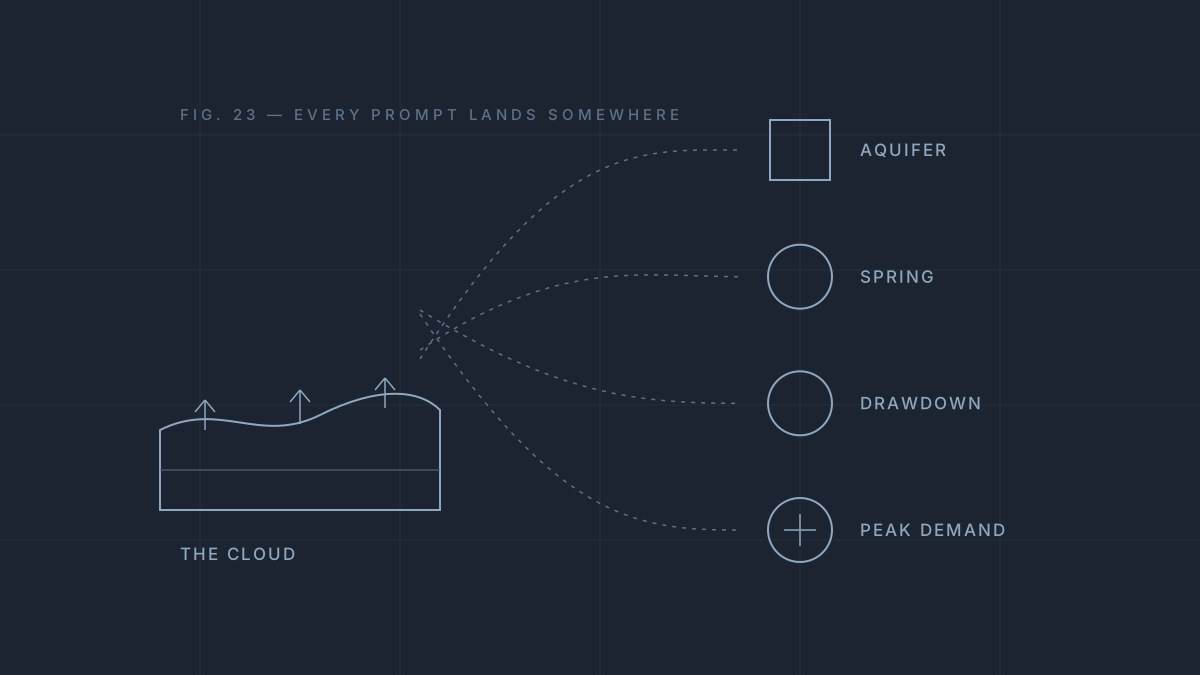
They remind us that the invisible eventually becomes visible. Rain becomes groundwater. Groundwater becomes spring flow. Pumping becomes drawdown. Drought becomes scarcity. Computation becomes heat. The cloud becomes infrastructure.
Every prompt lands somewhere.
The cloud has a watershed.
Core Pattern A resource burden that appears negligible at national scale can be transformative at the wellhead; digital infrastructure conceals its material metabolism behind a frictionless interface, so its true cost is only legible when measured locally, at peak, across the whole connected system.
What This Alters It moves the evaluation of AI infrastructure from the parcel and the annual average to the watershed and the drought-year peak — and reframes spare water capacity not as an idle commodity but as community resilience.
Resonant Line The experience is frictionless because the friction has been moved elsewhere.
Passages for Transmission
- The bottle may contain enough water. The pipe may still be too small.
- A burden that looks negligible from Washington can be transformative from the wellhead.
- Every prompt lands somewhere. The cloud has a watershed.
Source WFSU's Coast to Canopy — Florida's springs, drought, and data centers (YouTube). Figures drawn from the USGS on the Floridan Aquifer, Drought.gov, Lawrence Berkeley National Laboratory's 2024 data-center energy report, recent research on data-center water capacity, and Florida Senate Bill 484 (effective July 1, 2026).