
Signal
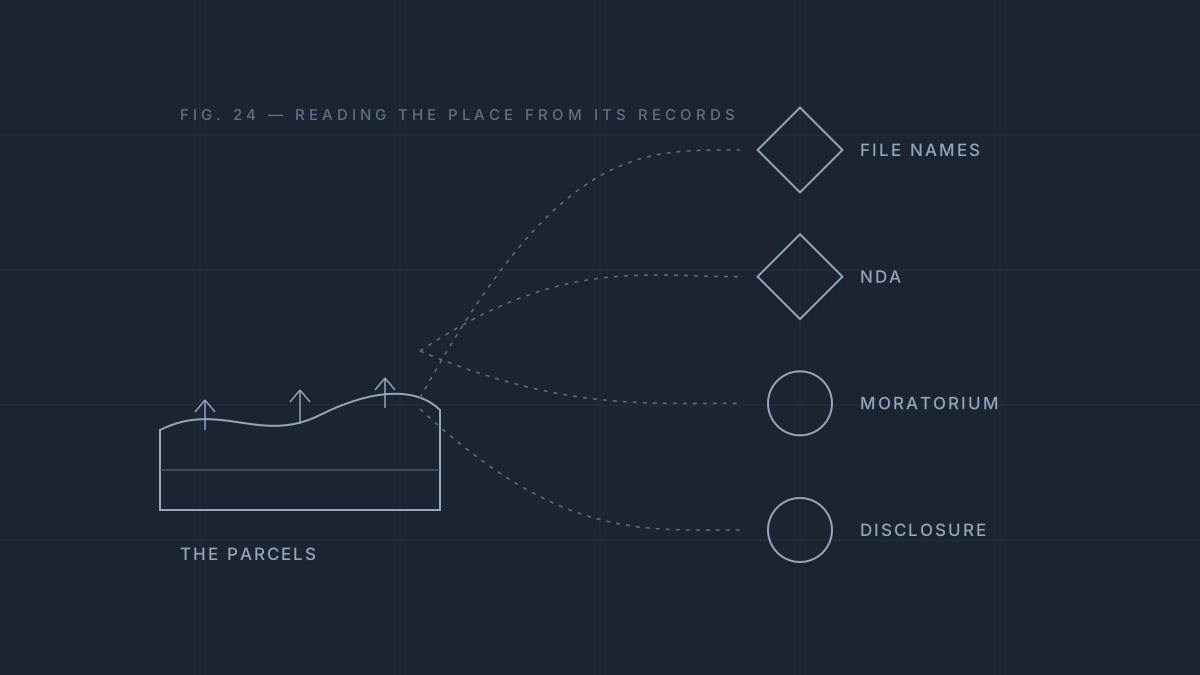
The parcel numbers arrived as file names in a public-records response.
Most people would have scrolled past them.
Robin San Vicente did not.
According to reporting by the Daily Sun, residents traced those numbers to three properties totaling approximately 103 acres in eastern North Port, near Yorkshire Street, Saraca Terrace, Langlais Drive, and North Yorkshire Street.
The properties are owned by North Port Holdings 300 LLC. Florida corporate records list the company as an active limited liability company based in Valley Stream, New York, with Avi Peretz as its registered agent and Avshalom Peretz as an officer.
Residents believe the parcels may be the site of the data center application recently submitted to the City.
The City has not publicly confirmed that conclusion.
That distinction matters.
What residents have assembled is a credible identification based on parcel records and the fragments available to them. It is not yet an official site disclosure.
A resident should not have to become a forensic cartographer to understand what may be built beside a neighborhood.
Yet that is how North Port's data-center story entered public view.
The formal application was submitted at 10:33 p.m. on July 20, 2026 — the night before the City Commission was scheduled to discuss whether North Port needed a moratorium on data centers.
A confidentiality request had been made in August 2025. A one-year nondisclosure agreement was signed in October. City staff reportedly had more general discussions with the developer for over five years.
At the July 21 meeting, City Manager Jerome Fletcher confirmed that North Port had received one application. Thirteen residents spoke in person, all in opposition, with additional public comments read into the record. After more than two hours of discussion, commissioners voted unanimously to begin advancing an 18-month moratorium intended to include applications already submitted.
The sequence proves neither misconduct nor predetermined approval.
It reveals something more structural.
North Port had institutional awareness of the possibility before it had a public operating model for evaluating it.
The Land Has Waited
Yorkshire was platted for houses that never arrived.
A road grid was drawn across the eastern landscape, but much of the anticipated development did not follow. Vegetation reclaimed portions of the streets. The area became, depending on who was describing it, an abandoned subdivision, an environmental asset, an enforcement problem, a future employment district, or a large reserve of buildable land.
The land has waited.
Before the data-center application, the future imagined for Yorkshire already included business parks, corporate headquarters, and the infrastructure required to serve them. Large landholdings controlled by North Port Holdings 300 LLC were part of that conversation.
A data center is therefore not appearing on a blank map.
It is entering an unresolved argument about what eastern North Port is for.
That distinction is important because a project of this scale is not simply placed on land.
It begins reorganizing the land around itself.
A large electrical load may require substations, transmission improvements, and new utility corridors. A cooling system may alter water and wastewater planning. Campus entrances can determine which roads are improved and which development becomes easier afterward. Security, lighting, drainage, generators, fuel storage, and emergency-response requirements can reshape the operating character of an entire district.
The effects do not stop at the property line.
Residents have raised concerns about nearby homes, water supply, continuous industrial noise, Florida scrub-jay habitat, and the larger ecological landscape surrounding Orange Hammock Wildlife Management Area.
Some of those effects may ultimately be mitigated. Some may prove less significant than feared. Others may become defining constraints.
The point of a public process is to find out before the infrastructure begins narrowing the available choices.
A 103-acre land-use decision can become a 30-year regional pattern.
Pattern
This is not primarily a story about servers.
It is a story about timing, opacity, and the difference between what land is technically zoned to accommodate and what a place is still willing to become.
The pattern is larger than North Port.
Wherever the artificial-intelligence infrastructure boom encounters open land and residual local authority, a familiar choreography is emerging:
Early confidential conversations. A late formal application. Public discovery through incomplete records. Urgent demands for a moratorium. An attempt to define the use after the use has already arrived.
Sarasota County began moving toward a one-year freeze after an inquiry involving a possible hyperscale facility. Commissioners cited water, electricity, noise, environmental degradation, and the difficulty of fitting modern data centers into zoning categories written for older forms of commercial and industrial development.
North Port is now considering an 18-month pause while already holding an application.
The application did not merely arrive before a final decision.
It arrived before the vocabulary.
The Application Arrived Before the Vocabulary
North Port's Unified Land Development Code does not specifically define data centers as a separate use.
City staff advised commissioners that they might instead be interpreted as light industrial, heavy industrial, or essential-service facilities. The same staff report described hyperscale centers as potentially exceeding one million square feet, occupying more than 100 acres, and requiring more than 100 megawatts of power.
Those older categories cannot fully carry the new load.
A hyperscale data center may resemble a collection of industrial buildings. Functionally, it is something more complicated. It is a utility-scale electrical load. A cooling system. A telecommunications node. A secure industrial campus. A collection of generators, batteries, transformers, and fuel systems. A continuous operation capable of producing heat, light, sound, traffic, and emergency-service demands.
And increasingly, it is a physical foundation for artificial intelligence.
The cloud has always been a misleading metaphor. There is nothing weightless about it. Every digital operation eventually resolves into land, electricity, cooling, transmission equipment, minerals, concrete, water, and heat.
The exact burden of this project remains unknown because the project-specific design remains largely unknown.
What kind of cooling will it use? What water source is proposed? What is the opening electrical load? What is the maximum buildout? What transmission and generation improvements would be required? How many backup generators? How much fuel? What would the tonal and low-frequency noise profile be at the nearest home? What permanent employment and tax revenue would be created relative to the land and utility capacity consumed?
Until those questions are answered, neither the project's economic promise nor its environmental burden can be responsibly calculated.
Generic assurances are not enough. Generic horror stories are not enough either.
The design matters.
That Is Not Planning. It Is Forensics.
Florida law permits certain information about a private company's plans to locate, relocate, or expand to remain confidential for 12 months after a written request. Outside the data-center context, that confidentiality may be extended for another 12 months under specified conditions.
That law helps explain the redacted records and the City's reluctance to confirm the applicant or site.
It does not eliminate the civic problem created by the resulting information gap.
A city may have a legal duty to protect a company's identity, proprietary plans, or negotiating position. It still has a public duty to prepare rules for the consequences.
It can define acceptable noise before knowing the company's name. It can establish water-use standards before seeing a cooling diagram. It can determine who must pay for utility expansion before calculating the exact load. It can map habitat, drainage, homes, wells, emergency routes, and infrastructure limitations before an applicant asks for approval. It can identify what information must become public before a decision becomes binding.
Florida's new data-center law reflects this distinction. Senate Bill 484, now Chapter 2026-65, preserves local land-use authority, eliminates the additional 12-month confidentiality extension for data-center projects, creates specific water-permitting provisions, and requires utility rules intended to prevent the costs and risks of serving large-load customers from being shifted onto ordinary ratepayers.
The initial confidentiality period remains. The obligation to prepare remains too.
When development discussions extend across years but the first usable public signal is a set of parcel numbers embedded in file names, the community is left to reverse-engineer its own future from residual records.
That is not planning.
It is forensics.
Implication
The deepest question is not whether every data center is inherently good or inherently bad.
It is whether North Port can preserve the capacity to make an informed decision before private momentum becomes public inevitability.
Large infrastructure projects create path dependence. Once a substation is built, a transmission corridor established, a utility extension financed, or a major road improved, the range of future choices changes. Some forms of development become easier. Others become less likely.
The infrastructure begins selecting the future.
This is especially consequential in Yorkshire, where the future has remained unsettled for decades. The original residential future did not arrive. The proposed employment-center future remains incomplete. Now a computing-infrastructure future may be attempting to write itself onto the same lines.
The decision should not be confined to whether one application satisfies today's most convenient interpretation of yesterday's code. It should ask what North Port wants the eastern city to become — and what capacities, landscapes, and options it is unwilling to lose in the process.
What the Moratorium Must Produce
A moratorium is not a plan. It is borrowed time.
Used well, it gives North Port space to develop definitions, standards, technical capacity, and public expectations before an application accumulates irreversible momentum. Used poorly, it delays the same argument for 18 months.
The pause should produce a civic operating framework, not merely a new definition in the land-development code.
Define the use. Distinguish among small, conventional, large-scale, hyperscale, and AI-oriented data centers. Regulation should respond to measurable impacts — acreage, peak electrical load, water consumption, generator capacity, building area, and proximity to sensitive uses — not only to whatever label an applicant chooses.
Map the load. Require disclosure of opening, phased, and maximum electrical demand. Identify the substations, transmission facilities, generation resources, and other infrastructure required to serve it. Show who pays, who owns the improvements, and who bears the risk if the promised campus is delayed, reduced, or abandoned. The public should not be asked to subsidize speculative capacity through higher rates or stranded infrastructure.
Trace the water. Require the cooling technology, source-water mix, daily and annual demand, wastewater discharge, reclaimed-water feasibility, drought-response strategy, and anticipated consumption at full buildout. A claim that a facility will be efficient is not a water budget.
Model the sound. Average decibels alone are insufficient. Cooling equipment, transformers, generators, and mechanical systems may produce tonal or low-frequency sound that travels differently and can be especially disruptive at night. The model should begin at the nearest home, not at the center of the parcel.
Map the living systems. Wetlands, drainage, tree canopy, scrub-jay habitat, wildlife movement, lighting, stormwater, heat, and the relationship to the Orange Hammock landscape should be evaluated as a connected system. Individual permits divide a landscape into regulatory pieces. The ecology still experiences the project as a whole.
Price the public exchange. Publish the expected permanent jobs, construction employment, tax revenue, incentives, exemptions, and public infrastructure costs. Measure emergency-response demands, road maintenance, hazardous-material storage, generator fuel, utility exposure, and eventual decommissioning. The relevant question is not only what the project will invest. It is what North Port will commit in return.
Make performance public. Approval conditions should become an operating agreement. Water use, electricity demand, generator operation, noise testing, environmental compliance, and major incidents should be reported through an accessible public record. Monitoring matters most after the ribbon cutting, when public attention has moved elsewhere but the facility continues operating every hour of every day.
Action / Posture
Attend the meetings. The August 4 gathering at Shannon Staub Library is an early opportunity for residents to compare records and questions. The August 31 and September 8 City Commission meetings will move the formal process forward. The September 3 outreach session with Florida Power & Light and the Peace River Manasota Regional Water Supply Authority should help clarify the infrastructure context.
Show up with facts, not only volume.
Ask whether the identified parcels are correct. Ask how the pending application will be treated during the moratorium. Ask what threshold will define a large-scale or hyperscale facility. Ask for opening and maximum electrical demand. Ask for the proposed cooling method and water source. Ask how low-frequency and nighttime sound will be regulated. Ask who pays for infrastructure required primarily by the applicant. Ask what information must become public, and when.
Request the redacted documents anyway. The redactions are part of the record. Track what remains concealed, the statutory reason given, and when the confidentiality period expires. Preserve agendas, public statements, technical presentations, meeting videos, and later changes in language.
Parallel civic memory forms in the gaps left by official process.
Do not outsource the long memory of the place to the next news cycle.
Undersong
The streets in Yorkshire were drawn for a future that never arrived.
Now another future is trying to write itself onto the same lines.
File names became coordinates. Coordinates became a possible site. The possible site became a public claim.
The claim remains unconfirmed and contested, but the deeper issue is already visible.
A data center is a machine for turning land, electricity, water, minerals, and infrastructure into computation.
The civic task is to reverse that process. Turn the computation back into land. Back into electricity. Back into water. Back into sound, cost, habitat, risk, and consequence.
Make the invisible system visible.
Then decide.
Places still have a right to remain legible to themselves. When the map is hidden in the file names, the work is to read them carefully — and then stand where the reading leads.
Core Pattern Large infrastructure increasingly arrives through a fixed choreography — years of confidential discussion, a late application, public discovery through fragments — so that a community is forced to define what a use is only after that use is already inside the system.
What This Alters It separates two civic duties that opacity tends to collapse: a city may be legally bound to protect an applicant's identity, yet remains free — and obligated — to build the standards, thresholds, and disclosures that will govern the consequences before any decision becomes binding.
Resonant Line When the map is hidden in the file names, the work is to read them carefully — and then stand where the reading leads.
Passages for Transmission
- A resident should not have to become a forensic cartographer to understand what may be built beside a neighborhood.
- The application did not merely arrive before a final decision. It arrived before the vocabulary.
- A data center is a machine for turning land, electricity, water, and minerals into computation. The civic task is to reverse that process.