Signal
Spend an afternoon reorganizing a real archive — a few hundred documents, several clients, projects nested inside projects — and the same friction surfaces at every turn: where does this one file go? The question feels like a filing problem. It is actually a design flaw, and an old one.
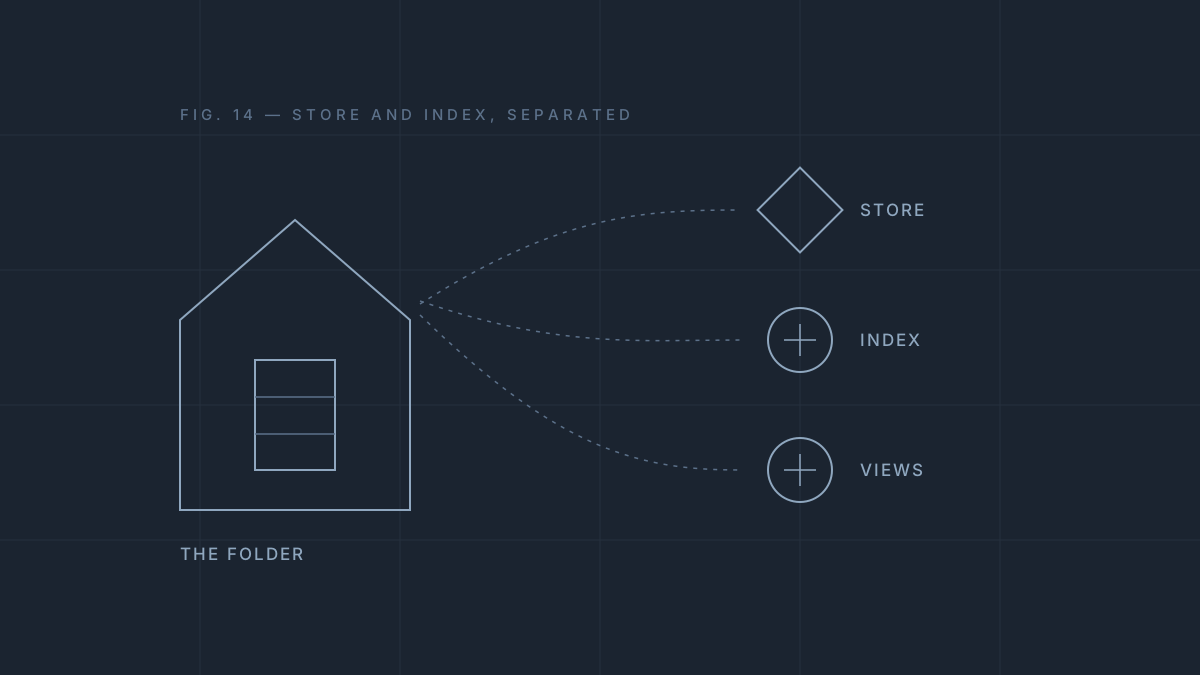
The folder hierarchy has always been asked to do two jobs at once. It is the store — the place the authoritative copy lives — and it is the index — the means by which you find that copy again. It had to be the index because, for fifty years, the only retrieval tools available were browsing a tree and searching on a filename. Weak instruments, both. So the structure itself had to carry the meaning: the path was the query.
What changes now is narrow but foundational. A tool that can read a document, reason about it, and tag it on sight decouples retrieval from location. Once you can simply ask for a thing, the folder no longer has to encode the map by which you'd otherwise hunt for it. The index job lifts out. And most of the filing anxiety lifts with it.
Pattern
This is not a story about software. It is an instance of a much older movement: infrastructure built to compensate for a missing capability outlives the arrival of that capability — but only by changing what it is for.
The hierarchical filesystem was itself a workaround. It arrived in an era with no cheap way to search meaning, and it stood in the same lineage as the card catalog, the Dewey Decimal number, the back-of-book index: prosthetics for retrieval. Each of those is, in the end, a confession — a careful record of what search could not yet do on its own. When the missing capability finally shows up, the scaffold rarely disappears. Its role contracts to the thing it was always uniquely good at, and it lets go of the thing it was only ever standing in for.
Enterprise architects have a name for the two halves this splits into. There is the system of record — durable, authoritative, singular — and the system of engagement, where the actual work and discovery happen. For decades the folder tried to be both. It was never very good at being both.
Implication
The first thing to dissolve is the constraint that quietly caused all the pain: one file, one place. A document is never really one thing. A budget is simultaneously a client, a project, a category, a year, and a draft. The tree forces you to elect one of those to be its "real" location and to demote the rest to memory. Lift the index out, and the file can hold all of its dimensions at once. The hierarchy becomes one projection among many, rather than the single lossy one you were obligated to pick.
What remains for the folder is what hierarchy alone does well: ownership, permission, lifecycle, retention, the clean unit you archive or hand to a successor. These are tree-shaped concerns, and they do not evaporate.
The second-order effect is the interesting one. The interface to your own information becomes conversational — you ask rather than navigate — and the folder quietly changes category. It stops being a place you visit and becomes a contract other things depend on: a stable address for tools, agents, and the occasional human working without any of them.
That last clause is the caution. It is tempting, seeing all this, to abandon structure entirely for a metadata-only pile and let the smart layer sort it out. That is a fragile bet. Tags are vendor-specific and rarely survive a zip file or a move between systems; a path is dumb, but it is the most portable metadata that exists. A structure that only works while the intelligence is present has no floor when the intelligence is absent — and intelligence, like any service, is sometimes absent.
Posture
The move is not to tear the tree down. It is to invert its job.
Keep the hierarchy thin, stable, and organized by ownership and lifecycle rather than topic. Grant it one responsibility: to be the canonical home where each record durably lives. Then push all the richness — every way you might ever want to slice the collection — into the layer above it: tags, queries, an agent that files and finds on request. One home for the record; infinite views for the work.
And design for the day the clever layer is missing. If a person with nothing but a file browser can still open the tree and understand it, you have built something that degrades gracefully. If they cannot, you have built a dependency and called it a system.
Think of folders, now, as an API rather than an interface. Not the surface you look at, but the stable set of addresses everything else is written against.
Undersong
Every index is a confession of what search could not yet do. The card catalog admitted it; the folder tree admitted it for half a century. When retrieval finally catches up, the honest response is not to demolish the index but to let it stop pretending to be the whole system — to settle from interface into infrastructure, from the thing you search into the floor you build on.
Structure endures by becoming humble. It gives up the meaning it was never able to hold, and keeps only the durability nothing else can provide.
Core Pattern Infrastructure built to compensate for a missing capability outlives that capability only by narrowing to the single job it alone performs.
What This Alters Retrieval detaches from location; the folder stops being where you find a thing and becomes where it durably lives.
Resonant Line Every index is a confession of what search could not yet do.
Passages for Transmission
- The folder tree was forced to be both the store and the index; agents relieve it of the second job, and most of our filing anxieties leave with it.
- One canonical home for the record; infinite views for the work.
- Tags are fast but fragile; paths are dumb but durable — build so the dumb layer still stands when the fast one is gone.
Drafted from a working session on reorganizing a multi-client document archive, and the questions it surfaced about what file structure is for in an age of agentic tools. Internal notes; no external source.