
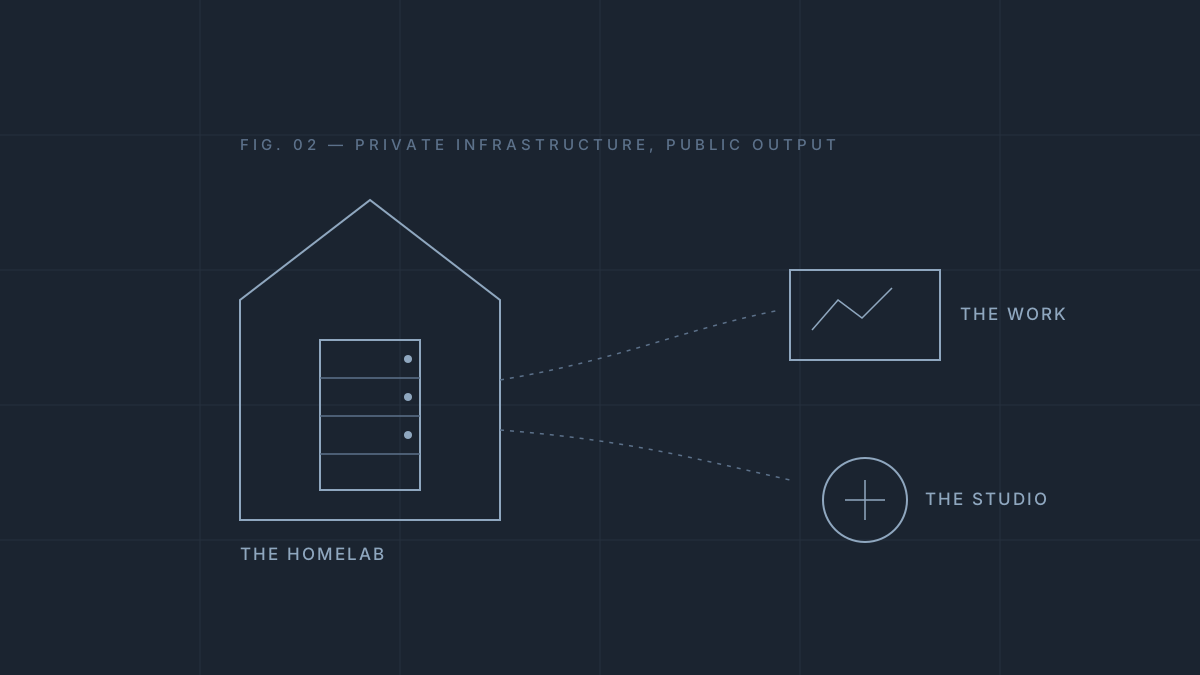
The Homelab Is Becoming the Studio
There is a strange shift happening beneath the surface of software.
Not in the venture-backed headlines. Not in the AI demo reels. Lower. Quieter. Closer to the floor.
People are beginning to build their own infrastructure again — not because they want to become system administrators, but because the shape of modern work increasingly demands a private layer beneath the public internet.
The old model assumed your tools lived somewhere else. All rented. All fragmented. All dependent on interfaces and business models you do not control.
But AI changes the gravity of that equation.
Because once software becomes conversational, the real value is no longer the app itself. The value becomes: the context, the memory, the structure, the relationships, the continuity.
The Return of Local Infrastructure
There is a growing category of people quietly assembling a modern personal operating environment: mini PCs, private GitHub repos, Docker stacks, markdown libraries, Tailscale networks, local AI runtimes, semantic search layers.
Not because it is trendy. Because it restores coherence.
Markdown as Infrastructure
One of the most important shifts happening right now is the re-emergence of Markdown — not as a writing format, but as a substrate.
Because Markdown is simultaneously: human readable, machine readable, AI readable, portable, durable, git-friendly, future-proof, composable.
The Studio Model
Perhaps the better metaphor is not homelab. Perhaps it is: studio.
A space where artifacts accumulate, systems evolve, ideas remain connected, experimentation becomes persistent, AI becomes collaborative rather than transactional.