Signal
It usually begins with something small and physical. A hum that doesn't stop at night. A well that runs dry in a wet year. A water bill that jumps from $40 to $800 with no explanation the utility is willing to give. Livestock behaving strangely. Water coming out of the tap discolored. In some households near new data center campuses, residents describe chronic fatigue and seizure-like episodes they cannot explain and cannot get investigated.
In a July 2026 conversation on the Shawn Ryan Show, Erin Brockovich — four decades into the work of forcing hidden contamination into public view — described what whistleblowers and residents have been reporting to her from towns near AI data center construction. The individual reports vary. The shape repeats: facilities that can consume up to 30 million gallons of water, cooling demands she compares to the water use of a city of 50,000 people, runoff carrying PFAS and other industrial compounds with little to no regulatory framework watching it, constant mechanical noise that disturbs both people and wildlife, and energy demands large enough to reshape regional grids.
And around many of these projects, a second structure: the non-disclosure agreement. Land deals, utility arrangements, and municipal negotiations conducted under NDAs that prevent the people who will live beside a facility from learning what it is, what it will draw from the aquifer, or what it will discharge — until it is already there.
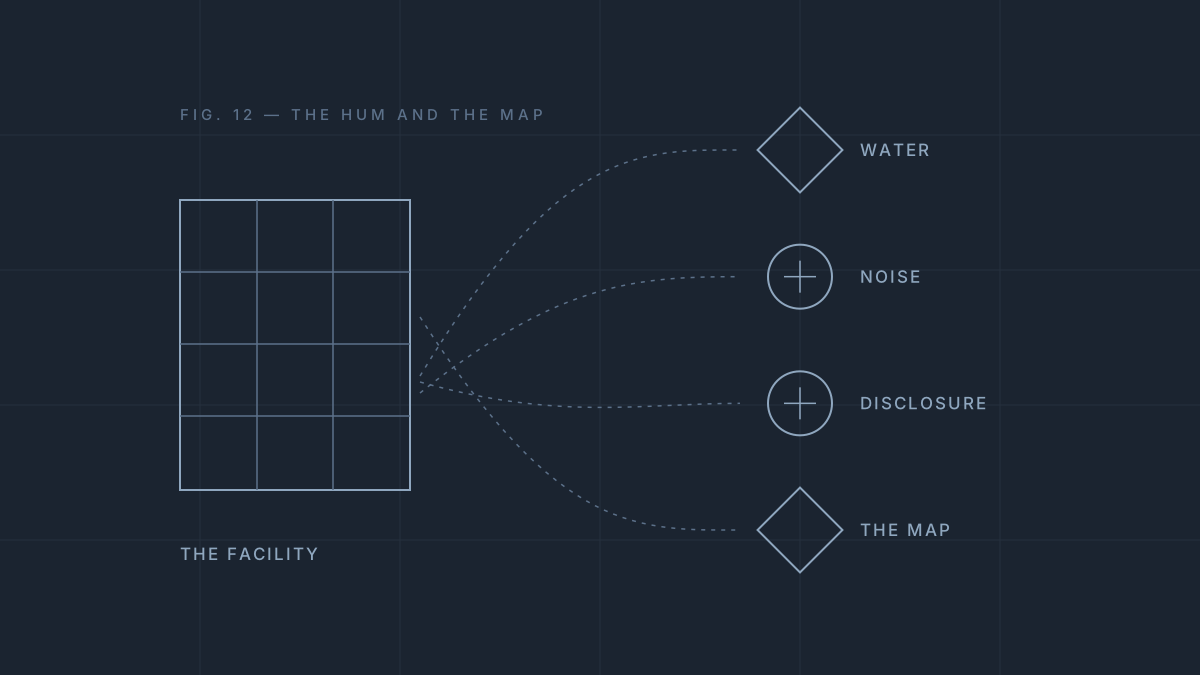
Brockovich's response was not a lawsuit. It was a map. She built a public self-reporting site, brockovichdatacenter.com, where residents log what is being built near them and what they are experiencing. In its first ten weeks it received thousands of submissions — sites across the United States, and some beyond it.
The signal is not simply that data centers use water. It is that a parallel, unofficial map of the AI buildout is being drawn by the people living next to it, because the official one is under seal.
Pattern
Brockovich has seen this sequence before, because she helped expose its most famous instance. In Hinkley, California, Pacific Gas & Electric contaminated groundwater with hexavalent chromium for decades while assuring residents the water was safe. The playbook — deny, delay, settle when forced — predates her: she invokes the Ford Pinto as the model, the corporate calculation that paying lawsuits later is cheaper than fixing the problem now. Flint followed the same arc with lead. Hannibal, Missouri fought its own version. The industries change. The sequence does not. As she put it: "We're doing the exact same thing over and over again just expecting a different result."
The pattern has three moving parts, and all three are present in the data center reports.
First, extraction that is invisible by design. Groundwater drawdown, chemical discharge, and grid strain do not announce themselves. They surface as symptoms — the dry well, the strange bill — long before they surface as causes. A facility behind a berm and a tree line looks like nothing at all.
Second, information asymmetry maintained on purpose. The NDA is the modern version of PG&E's reassuring letters. It does not poison anything. It only ensures that the people bearing the risk cannot price it, question it, or organize around it until the concrete is poured. Secrecy is treated as a development incentive; the community's ignorance is part of what is being sold.
Third, a lag between damage and discovery that favors the operator. By the time the pattern is undeniable, the infrastructure is essential, the jobs are counted, and the burden of proof has quietly migrated onto the sick.
What is different this time is the speed and the scale. The proposals are arriving in a surge, in county after county at once — and so is the response. Brockovich describes pushback that does not sort by party: farmers and retirees, conservatives and environmentalists, showing up at the same council meetings with the same two questions. How much water? Who agreed to this?
Implication
Beneath the individual disputes, several things come into focus.
The first is that water, not computation, is the binding constraint. Brockovich tells a story about her father, who worked in industry his whole life and told her that water would one day be more valuable than gold or oil. That is not a metaphor in a county where the aquifer is shared between a data center's cooling loops, a cattle operation, and a thousand private wells. Chips can be fabricated faster. Models can be trained more efficiently. An aquifer recharges on its own schedule, and no term sheet changes it. Any technology whose growth curve intersects a fixed water supply will eventually be governed by the water, whether or not anyone plans for it.
The second is that the true cost of intelligence is being settled onto the people least equipped to contest it. The value of an AI query accrues globally; its water, noise, and grid costs land on a specific rural road. This is the oldest move in industrial economics — privatize the gain, distribute the burden — but its application to AI is uncomfortable precisely because the product feels weightless. Every effortless answer has a watershed somewhere behind it.
The third implication is quieter: the erosion of local sovereignty as a side effect of secrecy. A town that cannot know what is being built cannot meaningfully consent to it. Zoning hearings, comment periods, and council votes still occur, but they occur inside an information vacuum, which converts democratic process into ceremony. The damage here is not only environmental. Trust between residents and their own local institutions is a form of infrastructure too, and it does not recharge quickly either.
And there is a cultural cost that Brockovich circles without naming directly. A society that outsources more of its thinking to machines while losing track of its water is running the same experiment at two scales: trading self-knowledge for convenience and hoping the bill never arrives. Stewardship — of a well, of land, of one's own attention — is a single instinct. It atrophies together.
None of this is an argument that the facilities should not exist. It is an argument that they cannot be legitimate while their costs are sealed. The question the map is forcing is not whether AI infrastructure gets built, but whether it gets built the way Hinkley's plume was built — quietly, on other people's water — or in the open, where its real price can be negotiated.
Posture
Brockovich titled her book Superman's Not Coming, and she means it as liberation, not despair. No agency, celebrity, or lawsuit is en route to handle this for anyone. People show up — that is the entire mechanism, and it has repeatedly proven sufficient.
What showing up looks like, practically:
Go to the meetings. Data center approvals run through planning commissions and county councils — bodies that ordinary residents can address, and that have already delayed or reshaped projects when rooms filled up. Local government is where this is actually decided.
Demand the numbers before the permit. Water source and projected draw. Energy plan. Cooling chemistry and discharge path. Noise profile. Facility size and expansion rights. A project that cannot disclose these has answered the question by refusing it. Support pauses and moratoriums whose purpose is assessment — not obstruction, but sequencing: understand the draw before granting it.
Write it down, and put it on the map. Baseline your well now — quality and depth, dated and photographed — so change is provable later. Log what you observe at brockovichdatacenter.com. Thousands of individual reports become a pattern no single NDA can contain. Public records, utility filings, and permit applications are more searchable than they have ever been; the same class of tools driving the buildout can be turned toward its transparency.
Build the unlikely coalition. The rancher worried about the aquifer and the parent worried about the substation want the same disclosures. Brockovich's observation from the road is that this issue does not polarize the way most do. Water is upstream of politics.
Verify everything — including the alarms. The posture that wins is the one that communities can sustain and officials cannot dismiss: documented, specific, calm. Not every hum is a harm. The demand is not that the facilities be presumed guilty; it is that they stop being unexaminable.
For readers already living with watering restrictions, agricultural water math, or a private well — this is not someone else's story arriving from elsewhere. It is the same ledger. The household that knows its water, the farm that measures its draw, the road association that organizes before the rezoning notice: these are the small-scale versions of the discipline now being demanded at industrial scale. Resilience is mostly the habit of knowing your own systems before someone else's system arrives next door.
Undersong
Two sounds run through this story. The first is the hum — constant, low, engineered to be ignorable, the sound of extraction proceeding behind a fence. The second is quieter and older: the sound of neighbors comparing notes. A well log read aloud at a council meeting. A pin dropped on a shared map. A question asked in public that was supposed to stay under seal.
"Communities will handle the truth," Brockovich says, "but they can never handle the lie." That is the deeper rule beneath forty years of her cases, and beneath this one. The truth — even the hard version, that intelligence has a water bill and someone must decide who pays it — is something towns can organize around, negotiate with, and sometimes accept. The lie is what converts a land-use question into a betrayal, and a betrayal into decades of litigation and grief. The lie is the only unsustainable input.
Superman is not coming, and that is the good news. The response to hidden extraction has never been a rescuer. It has been the person who shows up, writes it down, and refuses to be the only one who knows. The land keeps its own records — in the water table, in the herd, in the quiet that used to be there at night. The map is how the people who live on it sing back.
Core Pattern Extractive infrastructure externalizes its costs onto nearby communities behind engineered invisibility and enforced secrecy, until disclosure — usually assembled by residents themselves — forces the real price into the open; the cycle repeats across industries because secrecy is cheaper than transparency until, abruptly, it isn't.
What This Alters It reframes the AI buildout as a water-and-consent question rather than a computation question: the binding constraints on the technology's growth are the aquifer beneath the facility and the legitimacy of the process that placed it there.
Resonant Line Communities will handle the truth — but they can never handle the lie.
Passages for Transmission
- Every effortless answer has a watershed somewhere behind it.
- The NDA does not poison anything. It only ensures that the people bearing the risk cannot price it, question it, or organize around it until the concrete is poured.
- Superman is not coming, and that is the good news: the response to hidden extraction has never been a rescuer, but the neighbor who shows up and writes it down.
Related Knowledge Threads Water-use compliance and agricultural/residential restrictions in Florida · rural advocacy, zoning protection, and road-association coalitions · local sovereignty against top-down extraction · toxin awareness and resilience in stressed environments · AI tools for public-records transparency and community knowledge · care farms, resilient housing, and next-generation senior living — all of which presume the same substrate this story is about: stable water, legible land, and infrastructure whose costs are known.
Source Shawn Ryan Show #322 — Erin Brockovich, July 16, 2026 (YouTube). See also Brockovich's public data center reporting map at brockovichdatacenter.com, her Substack, and her book Superman's Not Coming: Our National Water Crisis and What We the People Can Do About It.