
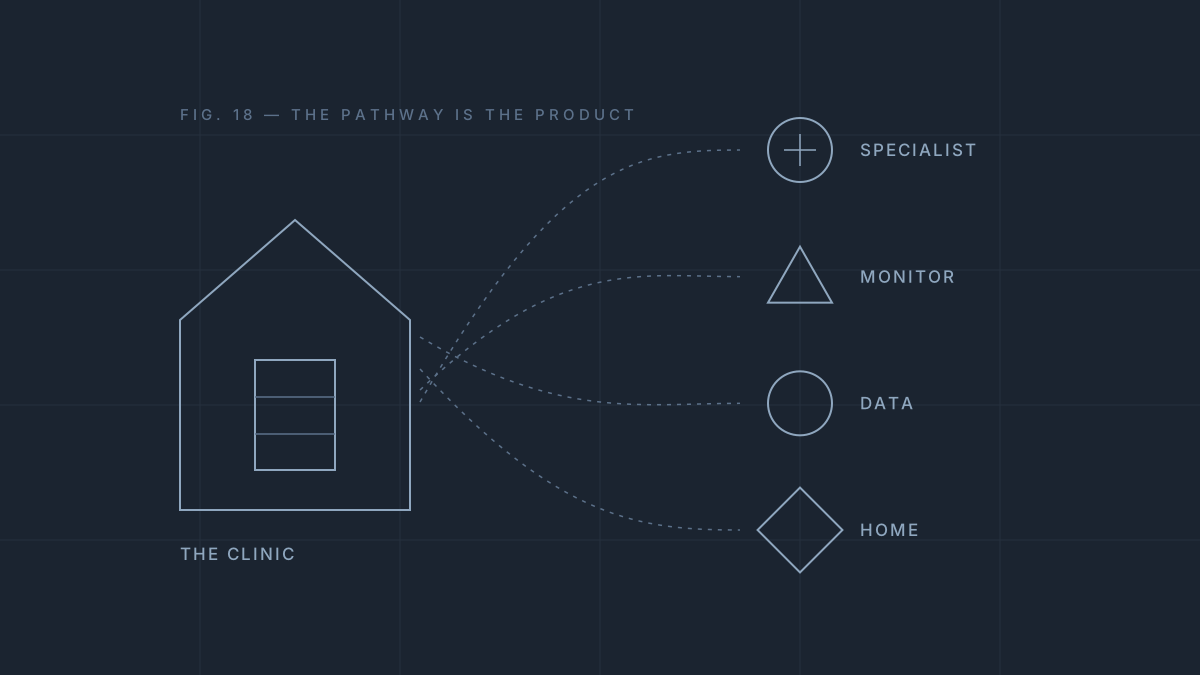
For years we have talked about healthcare innovation as if it were a parade of increasingly sophisticated devices.
A better scanner.
A smarter algorithm.
A robot with steadier hands than a surgeon.
An AI capable of writing clinical notes before the physician leaves the exam room.
The story is always the same: wait long enough and the next breakthrough will arrive.
But perhaps we've been looking in the wrong direction.
The most transformative technology is rarely the newest machine.
It is the connective tissue that allows every other machine — and every human being — to work together.
Scarcity Is the Wrong Frame
When we hear the phrase rural healthcare, our minds often jump to scarcity.
Too few physicians.
Too many miles.
Hospitals struggling to recruit.
Communities aging faster than they can replace caregivers.
The latest wave of Rural Health Transformation initiatives suggests something more hopeful. States are beginning to fund AI documentation, remote monitoring, robotic diagnostics, simulation-based workforce training, and regional specialist networks — not as isolated experiments, but as pieces of a larger transformation.
That is encouraging.
But it also exposes a deeper truth.
Technology isn't the destination.
Infrastructure is.
The Visible Machine, the Invisible Pathway
Undersong has returned to this idea repeatedly.
The visible parts of a system attract our attention.
The invisible relationships determine its performance.
A fascia network distributes force throughout the body.
An ecosystem survives because of countless unseen exchanges.
The internet succeeds not because of websites, but because of protocols.
Healthcare is no different.
An AI scribe isn't valuable because it can summarize a conversation.
It is valuable if it gives a physician another thirty minutes with patients.
Remote monitoring isn't revolutionary because a blood-pressure cuff can upload readings.
It matters only if someone knows when to intervene.
A surgical robot doesn't improve access merely because it exists.
It matters when geography stops determining who receives expert care.
The technology is visible.
The pathway is not.
The pathway is what changes outcomes.
Platforms Are Not Systems
This is the distinction many digital transformation efforts continue to miss.
Organizations purchase platforms.
Communities require systems.
Those are not the same thing.
A rural clinic doesn't need five disconnected AI tools.
It needs a coherent operating model that allows clinicians, patients, families, specialists, devices, and data to move as though they belong to one continuous conversation.
That conversation is infrastructure.
The Pattern Beyond Healthcare
This same pattern is emerging far beyond healthcare.
Education.
Manufacturing.
Agriculture.
Local government.
The question is no longer:
"Can AI do this task?"
It is becoming:
"Can our community absorb AI into the way work already happens?"
The winners won't necessarily own the smartest models.
They will own the strongest connective tissue.
The Quiet Future
For years we imagined the future arriving through spectacular demonstrations.
Humanoid robots.
Flying ambulances.
Autonomous hospitals.
Perhaps the real future is quieter.
A nurse who leaves work on time because documentation happened in the background.
A specialist who never had to travel because expertise traveled instead.
A patient who receives treatment in their hometown rather than driving four hours.
A physician who stays in a rural community because technology removed just enough friction to make the work sustainable.
The patient may never know which AI model made those moments possible.
Nor should they.
The greatest technologies eventually disappear.
Electricity stopped being remarkable when every building had it.
The internet stopped being impressive when every service depended on it.
Artificial intelligence will mature in much the same way.
Not as a product.
As infrastructure.
Undersong
That may be the real transformation underway.
Not that rural America is finally receiving advanced technology.
But that we are beginning to recognize what technology was always supposed to become:
Not another destination.
The connective tissue that allows human expertise to travel farther than people ever could.
Core Pattern In complex systems, capability accrues to the connective infrastructure that moves force, information, and expertise between components — not to the visible components themselves; the same relocation is now underway in how AI creates value.
What This Alters It moves the strategic question from "Can AI do this task?" to "Can our community absorb AI into the way work already happens?" — and relocates advantage from owning the smartest models to owning the strongest connective tissue.
Resonant Line The technology is visible. The pathway is not. The pathway is what changes outcomes.
Passages for Transmission
- The most transformative technology is rarely the newest machine. It is the connective tissue that allows every other machine — and every human being — to work together.
- Organizations purchase platforms. Communities require systems. Those are not the same thing.
- The greatest technologies eventually disappear — AI will mature not as a product, but as infrastructure that lets human expertise travel farther than people ever could.