
The conversation about artificial intelligence has focused largely on the machine.
How capable is it?
What can it automate?
Which professions will it reshape?
How quickly will it improve?
These are reasonable questions. But they direct our attention toward the most visible part of the transition.
The quieter change is happening on the other side of the interface.
As machines become more capable, the condition of the human mind becomes more consequential.
Not less.
More.
The McKinsey Health Institute calls this brain capital: the combination of brain health and the cognitive, interpersonal, self-leadership, and technological abilities people need to adapt, relate, decide, and contribute.
Its argument is economic. Competitiveness in the age of AI will depend on combining human and machine strengths rather than treating one as a replacement for the other.
The underlying idea is broader.
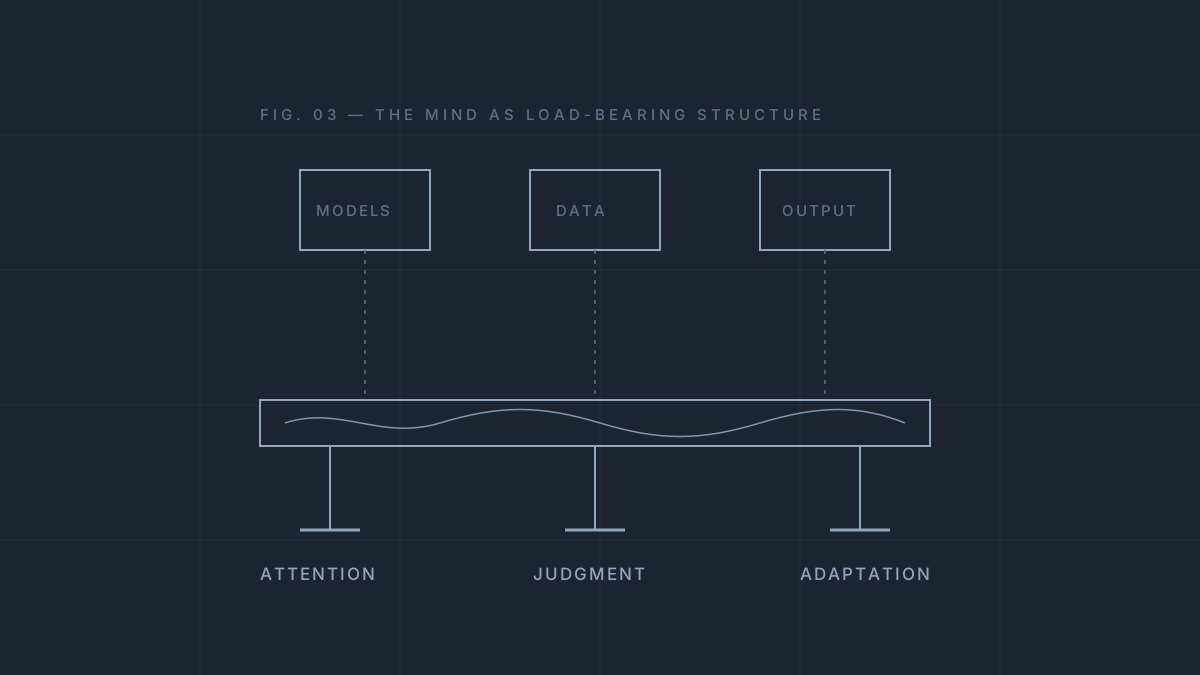
The mind is becoming infrastructure.
Intelligence was treated as an inexhaustible input
Most organizations have historically treated human cognition as something employees simply bring with them.
Attention arrives each morning.
Judgment appears when needed.
Adaptability is assumed.
Memory, curiosity, emotional regulation, creativity, and social intelligence are expected to remain available regardless of the environment surrounding them.
The organization invests in software, buildings, equipment, cybersecurity, and process improvement.
The mind operating all of it is largely left to manage itself.
This arrangement was strained long before generative AI.
Knowledge work had become an accumulation of notifications, meetings, dashboards, email, fragmented systems, and constant context switching. The human brain became the integration layer between tools that did not integrate with one another.
People called this productivity.
Often it was cognitive patchwork.
AI now enters that environment promising relief. It can summarize, retrieve, translate, draft, classify, schedule, and reorganize. Used well, it can remove a meaningful amount of mechanical effort.
But removing effort is not the same as strengthening cognition.
A system can reduce the need to remember while increasing the need to verify.
It can reduce the labor of writing while increasing the importance of judgment.
It can accelerate production while fragmenting attention.
It can generate more possibilities than a person has the capacity to evaluate.
The machine may lower the cost of producing an answer while raising the value of knowing whether the answer matters.
The scarce resource moves upward
Automation rarely eliminates value.
It relocates it.
When calculation became cheap, choosing what to calculate became more important.
When information became abundant, discernment became more important.
When content became easy to produce, trust became more important.
AI continues that movement.
The value of following a known process declines. The value of recognizing when the process no longer fits increases.
McKinsey distinguishes between using the brain to follow a familiar recipe and using it to invent a new one under pressure. The second category includes higher-order capacities such as metacognition, complex decision-making, creative and analytical thinking, resilience, and flexibility.
These are often described as soft skills.
There is nothing soft about them.
They are the capabilities that remain when the predictable portions of work have been compressed.
AI does not simply automate tasks at the bottom of a workflow. It pushes the human contribution upward—toward framing, interpretation, relationship, responsibility, and choice.
That may be the human advantage.
But an advantage is not the same as a guarantee.
A stronger tool can produce a weaker operator
There is a flattering assumption buried in much of the AI discussion: once routine work is automated, people will naturally move into more creative, strategic, and meaningful work.
Perhaps.
But higher-order work requires higher-order capacity.
A person depleted by chronic stress does not automatically become more strategic because software handled the meeting notes.
A worker choosing among six AI-generated drafts does not necessarily have more clarity than someone who wrote one draft directly.
A manager given faster access to more analysis may still lack the time, attention, or confidence to make a difficult decision.
The ability to use a powerful tool is shaped by the condition of the person using it.
Sleep matters.
Stress matters.
Physical movement matters.
Psychological safety matters.
Community matters.
The design of work matters.
McKinsey’s formulation of brain capital joins brain health with brain skills because the two are connected. Conditions such as stress, sleep, and community engagement can influence both a person’s health and their ability to learn, adapt, and perform.
This creates an uncomfortable possibility.
An organization can become technologically advanced while becoming cognitively fragile.
It can install AI across every workflow while degrading the human capacities required to supervise it.
The interface is not the environment
Most AI implementation begins at the interface.
Choose a platform.
Connect the data.
Train employees.
Define use cases.
Measure adoption.
These steps matter. But they are incomplete.
The deeper question is what kind of cognitive environment the organization is building.
Does the system protect periods of sustained attention?
Does it reduce unnecessary switching?
Does it clarify decisions or merely multiply inputs?
Does it make uncertainty easier to discuss?
Does it help less-experienced workers develop judgment, or quietly remove the experiences through which judgment was once acquired?
Does it preserve human contact where trust, mentorship, or care are part of the work?
Does it return time to people—or immediately fill the recovered space with additional output?
These are not wellness questions sitting beside the technology strategy.
They are technology strategy.
The performance of an AI-enabled organization will depend partly on its models and data, but also on whether the people inside it can think clearly enough to use them.
Cognitive debt
Software teams understand technical debt.
A shortcut saves time now but creates friction later. The system continues to function, although each future change becomes harder.
Organizations accumulate cognitive debt in much the same way.
Another dashboard is added.
Another communication channel is introduced.
Another approval layer appears.
Another recurring meeting is scheduled.
Another tool promises to unify the others.
Each addition seems manageable in isolation. Together they create a work environment that consumes attention simply to remain navigable.
AI could reduce this debt.
It could also conceal it.
A sufficiently capable assistant can help a person survive a badly designed system for longer. It can summarize the unnecessary meeting, search the disorganized archive, reconcile inconsistent documents, and draft the update no one needed.
The workflow feels faster.
The underlying disorder remains.
This may become one of the most important distinctions in applied AI:
Are we using intelligence to improve the system, or merely to tolerate it?
Brain capital is not an employee benefit
The phrase brain health can make this sound like a human resources initiative.
A meditation app.
A resilience seminar.
A set of wellness benefits offered alongside dental coverage.
That framing is too small.
If judgment, adaptability, communication, creativity, and technological literacy are central productive assets, then protecting and developing them is a form of capital investment.
McKinsey argues that these capabilities must be supported across the life course—from childhood through later adulthood. Maintaining them later in life can support continued independence, social engagement, protection from fraud, and longer participation in work when desired.
This matters because the AI transition will not occur within a single graduating class.
It will unfold across generations.
Young people will enter workplaces already shaped by AI.
Midcareer workers will be asked to revise methods they spent decades learning.
Older adults will encounter tools that can either extend independence and participation or introduce new layers of exclusion and risk.
The relevant unit is not simply the worker.
It is the human life course.
A society cannot build an adaptive economy while treating cognitive development as a childhood issue, mental health as a clinical issue, workplace stress as a personal issue, and cognitive aging as an eldercare issue.
These are different expressions of the same infrastructure.
The human advantage is a design choice
It is tempting to search for a permanent list of things humans will always do better than machines.
Creativity.
Empathy.
Judgment.
Meaning.
Perhaps some of these distinctions will endure. Perhaps the boundary will continue to move.
The more useful question may be different.
What human capacities do we want the age of AI to strengthen?
Technology does not answer that for us.
An AI system can extend curiosity or replace it.
It can create room for reflection or increase the velocity of demand.
It can support judgment or encourage passive acceptance.
It can deepen human relationships or become a buffer against them.
The outcome will depend less on what the tool is capable of than on what the surrounding system rewards.
The human advantage is therefore not simply something we possess.
It is something we either cultivate or spend down.
Beneath the productivity layer
The first era of workplace AI is being measured in output.
Hours saved.
Tasks automated.
Documents produced.
Costs reduced.
Those measurements are understandable. They are also incomplete.
A more mature accounting would ask:
Did attention improve?
Did judgment deepen?
Did people learn faster?
Did work become more coherent?
Did employees gain agency?
Did the organization become more adaptable?
Did the technology strengthen the person using it?
These outcomes are harder to place in a dashboard.
They may also determine whether the productivity gains last.
The important system beneath artificial intelligence is not only the model, the data center, or the software stack.
It is the mind that frames the question, notices the error, understands the context, accepts responsibility, and decides what should happen next.
We have spent enormous effort teaching machines how to work with language.
The next task may be learning how to build environments in which human beings can still think.
Source Note
This piece responds to the McKinsey Health Institute report The Human Advantage: Stronger Brains in the Age of AI, published January 15, 2026. The report defines brain capital as the combination of brain health and brain skills and proposes five broad areas of action: safeguarding brain health, fostering brain skills, studying brain capital, investing in it, and mobilizing coordinated action.