
For most of its modern life, the office did not need a particularly good reason to exist.
It contained the desks, files, phones, equipment, managers, and people required to do the work. Going to the office was not one option among several. It was simply where work was.
That assumption has been broken.
McKinsey’s examination of the future office begins with a material consequence: demand for conventional office space is expected to be lower by 2030 in many major cities. It proposes that the offices that remain will need four qualities: purpose, connection, digital enhancement, and sustainability.
Those are reasonable requirements.
But beneath them sits a more consequential change.
The office is no longer the container of work.
It is becoming one instrument within a larger system of work.
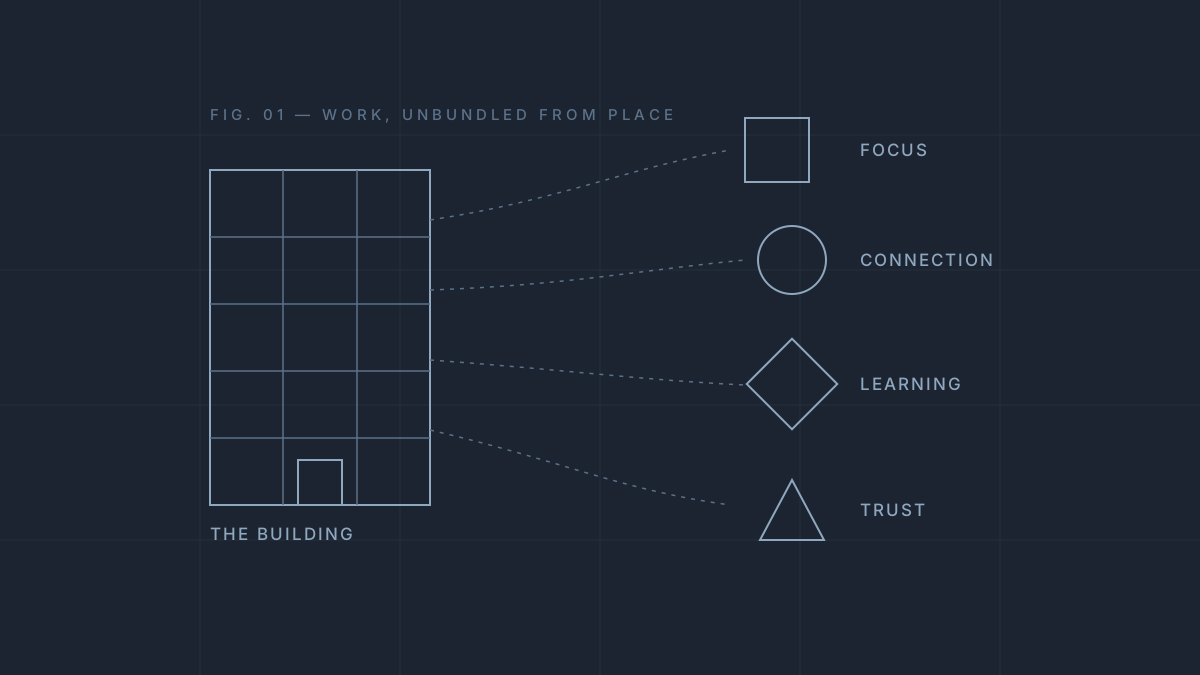
Work was unbundled from place
The traditional office bundled together several functions:
- a place to concentrate
- access to information and equipment
- supervision
- communication
- professional identity
- organizational culture
- informal learning
- social connection
- proof that work was occurring
Digital tools separated many of these functions from the building.
Documents moved to the cloud. Meetings moved to screens. Messages became asynchronous. Specialized software became accessible from almost anywhere. A laptop and a reliable connection could reproduce much of what once required an entire floor of commercial real estate.
The pandemic accelerated this transition, but it did not create the underlying capability. It exposed how much of office life had been preserved by habit rather than necessity.
Once the bundle was broken apart, each function could be evaluated independently.
Where is concentration best performed?
Which conversations benefit from physical presence?
How do new employees learn what is not written down?
When does proximity produce something that a video call cannot?
Which activities require a shared room, and which merely inherited one?
These are not primarily real estate questions.
They are questions about the architecture of work.
Presence is becoming a designed condition
The old office operated through default attendance.
The emerging office must operate through intentional presence.
That sounds like a small difference, but it changes nearly everything.
When attendance is assumed, an organization can fill space without explaining what the space is for. People arrive because the schedule says they should. The building can remain largely passive: rows of workstations, conference rooms, a break area, perhaps a reception desk.
When attendance becomes selective, the building must contribute something distinguishable.
The commute becomes a transaction.
Employees give time, attention, flexibility, and often money to make the trip. The organization must return something that could not have been obtained as effectively at home or through a screen.
That return might be:
- faster trust
- deeper collaboration
- apprenticeship
- difficult decision-making
- creative friction
- access to specialized environments
- a stronger sense of belonging
- contact with people outside one’s immediate workstream
The important question is no longer simply whether employees are in the office.
It is whether being there changes what becomes possible.
The office is social infrastructure
Much of the office debate has been framed as a contest between productivity and flexibility.
That framing may be too narrow.
Individual productivity can often be measured over short periods. Social capital accumulates more quietly. It appears in the colleague who knows whom to call, the junior employee who overhears how a difficult problem is handled, the relationship that makes a later disagreement survivable, or the chance encounter that connects two otherwise separate pieces of information.
These effects are real, but they are difficult to isolate. They emerge across time and through repeated contact.
This is one reason organizations struggle to articulate the value of the office. Its most defensible purpose may not be the visible work performed inside it. It may be the relationships and shared context that make future work easier.
The office, viewed this way, is not primarily a productivity machine.
It is social infrastructure.
But infrastructure must be maintained. Simply placing people in the same building does not create connection. A crowded calendar of video calls conducted from adjacent desks may technically satisfy an attendance policy while producing almost none of the benefits of proximity.
Presence and connection are not the same thing.
Amenities cannot substitute for purpose
A common response to reduced attendance is to make the office more attractive.
Better coffee. Softer seating. Wellness rooms. Plants. Hospitality-inspired lobbies. More polished collaboration areas.
These improvements may matter. Natural light, healthy air, outdoor access, adaptable interiors, and better technology can make a meaningful difference to the workplace experience. McKinsey includes many of these qualities in its vision of a more connected and sustainable office.
But amenities cannot answer the underlying question.
Why are we here?
An attractive office without a clear operating purpose is still an unclear office.
The danger is that organizations redesign the environment while leaving the work itself untouched. They replace cubicles with couches but preserve the same meetings, hierarchies, habits, and management assumptions.
The setting changes.
The system does not.
The future office will require organizational design as much as interior design. Teams will need to decide which activities deserve simultaneity, which benefit from proximity, and how in-person time should be structured so that it does not become a more inconvenient version of remote work.
Smaller may need to mean more specific
Lower demand for office space does not necessarily mean the office is disappearing.
It may mean the generic office is disappearing.
Organizations may occupy less space while expecting more from each square foot. A workplace could become a collection of deliberately different environments:
- quiet rooms for focused work between meetings
- project rooms that remain intact across several days
- spaces for teaching and apprenticeship
- settings for sensitive conversations
- studios for making, testing, and demonstrating
- informal areas designed for unplanned interaction
- places where customers, partners, and communities can enter the organization
The office becomes less like a warehouse for employees and more like a platform for particular kinds of encounter.
This shift also suggests that occupancy is an incomplete measure of success. A building can be full and accomplish little. It can also be lightly occupied while hosting the conversations, decisions, and relationships that matter most.
The more useful measure may be not how many people entered the building, but what the building helped them do.
A new compact with place
The future of the office is sometimes discussed as though the goal were to restore attendance to an earlier norm.
That may misunderstand the transition.
Once people experience work as something that can move across settings, place becomes negotiable. The office cannot return to being invisible infrastructure. Its costs—commuting, interruption, rigidity, concentration loss—are now more visible, as are its benefits.
This does not make physical space irrelevant.
It makes space accountable.
The office must justify itself through the quality of the experiences it enables, the relationships it strengthens, and the work it makes possible.
The same principle may extend beyond offices.
Schools, libraries, stores, clinics, community centers, and senior living environments all face versions of the same question as more transactions and services become digitally accessible:
What is the physical place uniquely capable of doing?
The answer will rarely be “housing the activity” alone.
The enduring places will be those that create conditions difficult to reproduce elsewhere: trust, belonging, discovery, care, participation, memory, and shared attention.
The office is not vanishing.
It is losing the privilege of being automatic.
And that may be the beginning of its becoming useful again.
Source Note
This piece responds to McKinsey & Company’s The future of the office, which describes reduced demand for traditional office space and identifies purpose, connectivity, digital enhancement, and sustainability as defining attributes of future workplaces.