
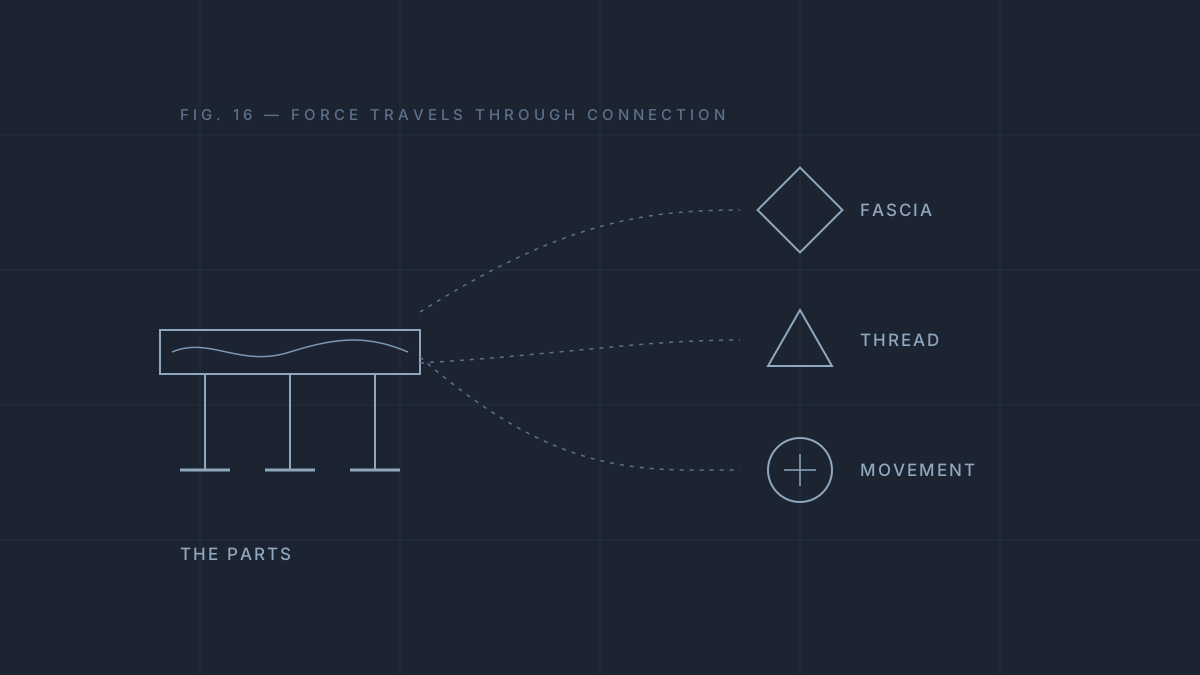
We tend to look for power in the visible parts.
The muscle. The machine. The application. The expert. The database. The model.
We isolate the component that appears to produce the result and then attempt to make it stronger, faster, smarter, or more efficient.
But complex systems rarely work that way.
The body does not generate useful movement through the independent strength of individual muscles. An organization does not become capable merely by assembling talented people. A technology ecosystem does not become intelligent simply because it contains powerful software.
The capacity of the system emerges through connection.
The power was never entirely in the parts.
It was in the way they moved together.
Signal
For generations, the dominant image of physical strength was muscular.
We imagined the body as a collection of motors attached to a skeleton: the quadriceps extend the knee, the biceps bend the elbow, the glutes drive the hips. Improve the individual muscle and the movement improves with it.
That model is useful, but incomplete.
Human movement is coordinated through a continuous network of connective tissue. Fascia surrounds muscles, crosses joints, stabilizes structures, distributes tension, and helps transmit force across the body.
A throw does not begin in the arm.
It begins against the ground, moves through the legs and hips, crosses the trunk, passes through the shoulder, and finally exits through the hand. The visible action occurs at the end of a chain whose effectiveness depends on everything remaining connected.
Strength isolated in one place is limited.
Strength transmitted through the entire system becomes movement.
Fascia does not replace the muscles. It allows their efforts to become coordinated.
It is not merely another part.
It is the condition through which the parts become capable together.
Pattern
Most modern systems are still designed around components.
We buy an application to solve one problem. We install a database to contain one category of information. We add a dashboard, a sensor, a camera, an artificial-intelligence model, or a new specialist.
Each addition may be useful.
But usefulness does not automatically become capability.
The camera sees the game. The scoring platform records the outcome. The training system measures the swing. The coach provides context. The athlete carries the history.
Yet the information remains divided among separate systems, accounts, interfaces, and moments in time.
The same pattern appears throughout healthcare.
A laboratory measures one biomarker. A wearable records another. A clinician documents a visit. A patient remembers symptoms. A hospital stores imaging. A pharmacy tracks medication.
Every part may function exactly as intended while the whole remains strangely unintelligent.
We have become skilled at producing information and surprisingly poor at preserving its relationships.
The missing ingredient is not necessarily another tool.
It is connective tissue.
Digital Fascia
A data fabric can be understood as a kind of digital fascia.
It does not need to replace every application beneath it. It connects them. It allows information created in one place to retain meaning as it moves into another.
In baseball, that might mean connecting streaming video, GameChanger scoring, player-development technology, training notes, roster information, health data, and coaching observations into a longitudinal record of the athlete.
The camera remains a camera.
The scoring application remains a scoring application.
The development platform remains a development platform.
But the relationships among them become usable.
A pitching change can be connected to velocity decline. A mechanical adjustment can be compared with later game performance. A hitter's results can be interpreted alongside the quality of contact, the opposing pitcher, the count, the practice emphasis from the prior week, and the athlete's development over an entire season.
The intelligence does not reside within any one source.
It emerges from continuity across them.
That is what connective tissue does.
It preserves relationship while allowing movement.
Organizations Have Fascia Too
Organizations often make the same mistake.
When work becomes difficult, they add a role, a platform, a committee, a consultant, or a new layer of reporting.
The assumption is that the organization lacks a necessary part.
Sometimes it does.
But often the parts are already present. What is missing is the tissue that allows knowledge, responsibility, and intent to move between them.
One person understands the history.
Another controls the budget.
Another manages operations.
Another holds the relationship.
Another has the technical expertise.
Another sees the emerging opportunity.
The failure occurs in the spaces between them.
No one carries the full thread across the system.
This is why certain people become disproportionately important inside institutions. Their job descriptions may not reveal it, but they translate across functions. They connect strategy to execution, technology to human need, past decisions to current constraints, and isolated efforts to a larger direction.
They are sometimes called integrators, operators, coordinators, translators, or quarterbacks.
Their deeper function is connective.
They are organizational fascia.
When this work is absent, every department can perform competently while the institution moves poorly.
When it is present, modest resources can produce surprising capability.
The False Promise of the Standalone Solution
Much of the technology market is built around the promise that one more product will resolve fragmentation.
The new platform will become the single source of truth.
The new artificial-intelligence assistant will understand everything.
The new system will replace the old systems.
Occasionally, that happens.
More often, the new solution becomes another part.
It creates another interface, another store of information, another partial view, and another dependency that someone must reconcile.
The answer to fragmentation is not always consolidation.
It may be orchestration.
Healthy connective tissue does not force every organ to become the same organ. It allows specialized structures to remain distinct while participating in a coherent body.
The better question is not:
Which system should replace everything else?
It is:
What allows these systems to function as one?
Implication
Artificial intelligence will make this distinction increasingly important.
Models are becoming capable of interpreting text, images, video, voice, sensor data, and structured records. But intelligence applied to disconnected fragments remains fragmentary intelligence.
An AI system may summarize a game, a medical visit, a financial report, or a project meeting.
The larger opportunity is not the summary.
It is the preservation of the thread.
What happened before? What changed? What appears repeatedly? Which observation matters only because of something recorded six months ago? Which weak signal becomes meaningful when joined with five others? What does this moment reveal about the direction of the whole?
These questions require more than access to data.
They require continuity, context, and relationship.
The systems that matter most may not be those that generate the most impressive isolated output. They may be the ones that quietly maintain connection across people, tools, decisions, and time.
Their value will be difficult to demonstrate through a single feature because their real product is coherence.
Golden Thread
We keep trying to improve systems by strengthening their visible parts.
Sometimes that works.
But as systems become more complex, the greatest constraints increasingly appear between the parts rather than within them.
The opportunity is therefore not merely to build better components.
It is to create better channels for force, information, memory, and intent to travel through the whole.
The body already knows this.
Power is not produced at a single point.
It gathers through relationship.
It travels through connection.
And only then does it become movement.
Core Pattern As systems grow more complex, the binding constraint migrates from the capability of individual components to the quality of the connective tissue between them — the channels through which force, information, memory, and intent travel.
What This Alters It reframes fragmentation as a problem of orchestration rather than consolidation, and relocates value from the impressive isolated output to the quiet maintenance of continuity across people, tools, and time.
Resonant Line Every part may function exactly as intended while the whole remains strangely unintelligent.
Passages for Transmission
- We have become skilled at producing information and surprisingly poor at preserving its relationships.
- Healthy connective tissue does not force every organ to become the same organ.
- Power is not produced at a single point. It gathers through relationship, travels through connection, and only then becomes movement.