Artificial intelligence is usually presented as software.
A model.
An interface.
A subscription.
A stream of answers arriving through a screen.
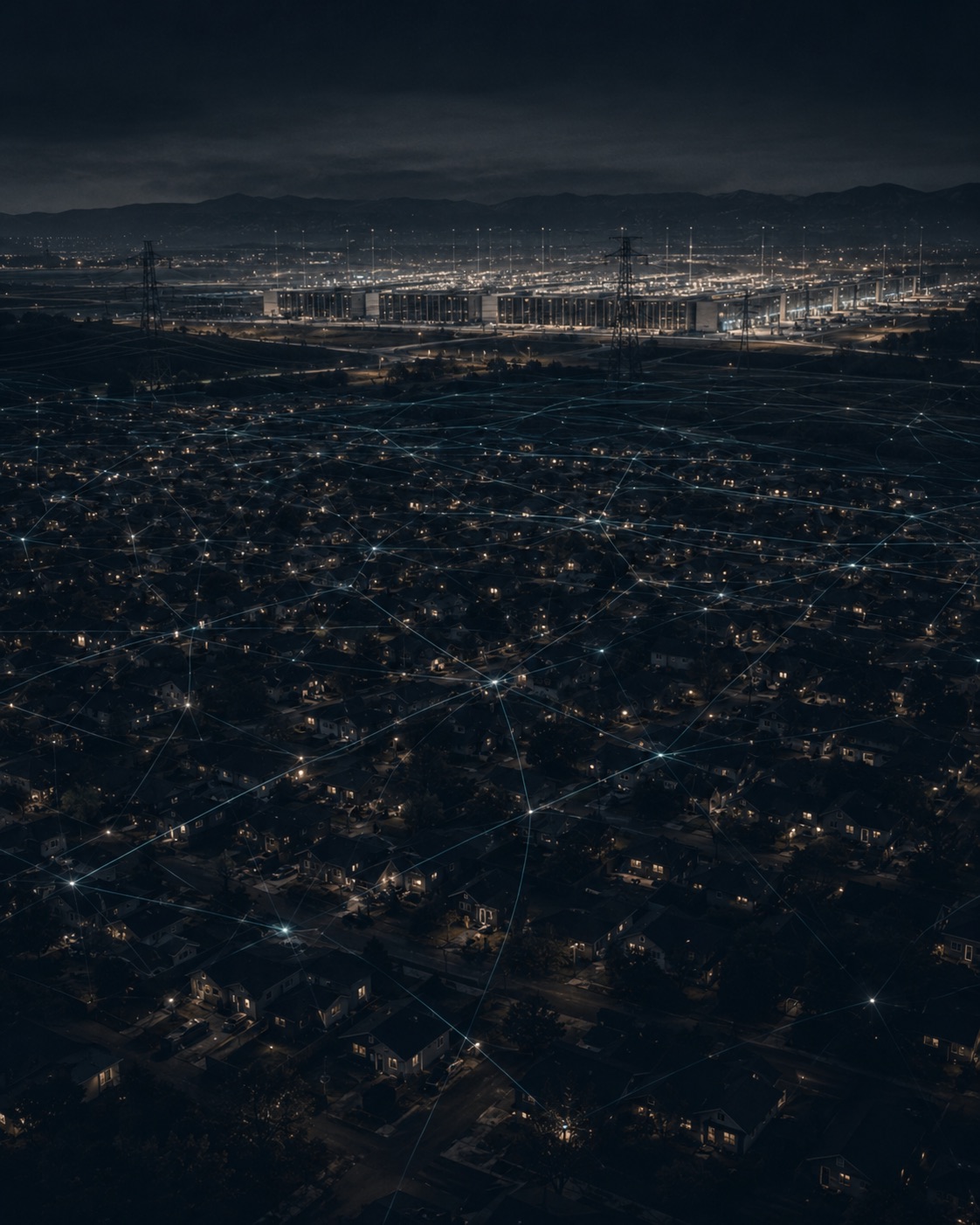
But the screen conceals the physical arrangement beneath it.
Land.
Water.
Transmission lines.
Substations.
Power plants.
Backup generation.
Long-term utility contracts.
And, increasingly, a question that has followed every major industrial transition:
Who pays for the infrastructure required to make it possible?
A recent Brookings article examines an emerging pledge by major AI companies to shield ordinary utility customers from the costs created by large data centers. The companies have committed, in broad terms, to cover the power-generation and delivery infrastructure their facilities require, accept separate utility rates, and continue paying for contracted capacity even when they do not use it. Brookings argues that the framework is plausible—but only if state legislatures and utility regulators turn the promise into enforceable rules.
The policy details matter.
But beneath them is a more familiar pattern.
Private systems grow quickly.
Public systems absorb the uncertainty.
The cloud has a utility bill
The language of cloud computing has always made infrastructure sound weightless.
Files float.
Applications scale.
Capacity appears on demand.
The metaphor is useful precisely because it removes the machinery from view.
Yet AI does not operate in the cloud in any literal sense. It operates in buildings connected to electrical grids that were not designed for demand arriving at this scale or speed.
Brookings identifies two central risks. The first is that the cost of new generation, transmission, and distribution infrastructure could be spread across all utility customers unless special rate structures isolate the costs created by data centers. The second is stranded investment: utilities could build expensive capacity for facilities that are delayed, abandoned, relocated, or rendered less power-intensive by future technological changes.
This is the part of the AI economy that rarely appears in demonstrations.
The model may be digital.
The risk allocation is not.
Someone must finance the infrastructure before the promised demand becomes real.
Someone must remain responsible if it does not.
Scale first, accounting later
Much of the technology economy has been built around a recurring sequence.
Growth arrives first.
Governance follows.
A new platform expands until its consequences become too large to ignore. Only then do institutions begin defining who is responsible for safety, labor, privacy, market power, or public cost.
AI infrastructure appears to be following the same path.
Data centers are proposed at a pace that can exceed the ability of utilities, regulators, and communities to evaluate them. The economic-development announcement often arrives before the full accounting of grid upgrades, water use, noise, tax incentives, backup generation, and long-term exposure.
The benefits are concentrated and legible.
Investment.
Construction.
Tax base.
Jobs.
Technological relevance.
The costs are distributed across systems that are harder to see.
A slightly higher utility bill.
A transmission project paid over decades.
A power plant justified by projected demand.
A neighborhood living beside industrial infrastructure.
A public utility carrying obligations after the original customer has left.
This is not necessarily evidence of bad intent.
It is evidence of mismatched time horizons.
Technology companies make decisions at the speed of markets.
Utilities build assets expected to last for generations.
Communities inherit what remains after the forecast changes.
A pledge is not a tariff
The emerging ratepayer-protection pledge recognizes an important principle: data centers should pay the costs they impose on the grid.
That sounds obvious.
It is not how shared infrastructure automatically works.
Utilities typically recover major investments through rates charged across classes of customers. Without carefully designed tariffs, some portion of the cost of serving a new large user can migrate into everyone else’s bill.
The Brookings authors argue that separate large-load tariffs and “take-or-pay” arrangements are essential. A data center would be required to pay for contracted capacity and related infrastructure whether or not it ultimately consumes all the electricity it requested. That obligation helps prevent households and smaller businesses from inheriting the cost of overbuilt infrastructure.
The distinction between a pledge and a tariff is the distinction between intention and architecture.
A pledge expresses what should happen.
A tariff determines what happens when conditions change.
When a project is delayed.
When demand falls.
When ownership changes.
When a facility closes.
When efficiency improves faster than expected.
When the political attention moves elsewhere.
Good intentions are most credible when they survive the moment in which keeping them becomes inconvenient.
The infrastructure must be able to say no
The debate is often framed around how quickly the grid can accommodate data centers.
How fast can projects be connected?
How much capacity can be added?
Which barriers can be removed?
Those are supply questions.
There is another question beneath them:
What obligations should accompany access to a constrained public system?
Infrastructure is not simply a service waiting to be consumed. It is a shared arrangement with physical limits, long lead times, and consequences for people who did not participate in the original transaction.
A utility commission that requires financial collateral, long-term contracts, minimum payments, and direct reimbursement for grid upgrades is not obstructing innovation.
It is asking growth to become accountable for its own forecast.
Virginia and Ohio have already adopted versions of this approach. Virginia created a separate rate class for very large energy users, with minimum payment requirements, lengthy contracts, and financial collateral intended to protect consumers if a project leaves before its infrastructure is paid off. Ohio requires certain large-load customers to cover upfront and build-out costs. Brookings notes, however, that protections remain uneven and incomplete across states.
The ability to say “not under these terms” is part of what makes infrastructure governable.
Without that ability, public systems become passive recipients of private demand.
The subsidy can hide inside the rate base
Public subsidies are usually discussed as visible transactions.
A tax credit.
A grant.
A discounted parcel of land.
An infrastructure incentive.
But subsidy can also occur through cost allocation.
When a systemwide investment is built primarily for one category of customer and the cost is spread across everyone, the subsidy disappears into the rate base.
No ceremonial check is presented.
No single budget line identifies the transfer.
It appears gradually, distributed among millions of monthly bills.
This is one reason rate design can sound technical while remaining deeply political.
A tariff is an answer to the question:
Who is responsible for what?
The arithmetic may be complex, but the principle is simple.
Households should not finance speculative infrastructure for some of the largest and best-capitalized companies in the world.
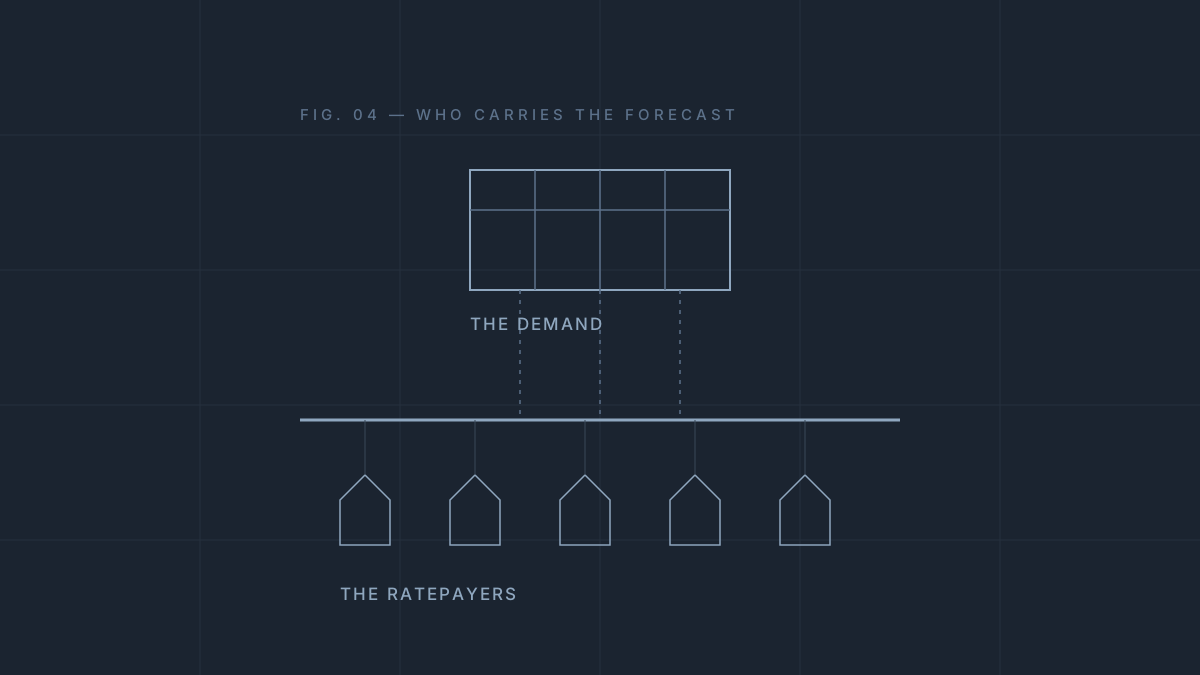
Small businesses should not become insurers of data-center demand forecasts.
Communities should not be asked to socialize the downside while the upside remains privately controlled.
The public grid can support private innovation.
It should not quietly become its financial backstop.
The problem is larger than electricity prices
Brookings also notes that public opposition to data centers is not driven solely by utility bills. Polling cited in the article suggests broader concerns about resource consumption, quality of life, environmental effects, and AI itself.
This matters because a narrow solution can be mistaken for a complete one.
A company may pay its full electricity costs and still place pressure on water systems.
It may fund a substation and still alter the character of a landscape.
It may comply with a tariff and still create noise, emissions from backup generators, land-use conflicts, or little local employment once construction ends.
Ratepayer protection is necessary.
It is not the same as community consent.
The larger issue is whether the places hosting AI infrastructure are being treated as partners in the system or merely as suitable locations for equipment.
The industry often describes data centers as critical national infrastructure.
That description carries responsibilities in both directions.
If these facilities are nationally important, their development cannot be evaluated only through private contracts and local tax incentives.
Their energy demand, resilience, environmental burden, economic value, and opportunity costs belong in the same frame.
Forecast risk should follow the forecaster
The most revealing issue may be stranded investment.
Utilities are being asked to build for demand that is both enormous and uncertain.
AI companies expect computing demand to continue rising. That may prove correct. But specific projects can still fail to materialize, and technology can change the amount of power required for a given amount of computation.
Brookings cites estimates suggesting that a substantial share of announced large data-center capacity may never be built.
This does not mean utilities should refuse to prepare.
It means the risk should remain attached to the party creating it.
The company requesting the capacity has more information about its plans than the household receiving an electricity bill.
It has more influence over whether the project proceeds.
It receives more of the financial benefit if the forecast proves correct.
It should therefore bear more of the cost if the forecast proves wrong.
This is not anti-growth.
It is one of the conditions that allows growth to remain legitimate.
The real price of intelligence
AI pricing currently presents a remarkably narrow picture.
A monthly subscription.
A per-token charge.
A cloud-computing contract.
The apparent price is separated from the infrastructure supporting it.
This makes intelligence feel inexpensive because many of its costs have not yet reached the interface.
The deeper accounting includes:
- the grid capacity reserved for future demand
- the transmission system expanded to serve it
- the generation built around it
- the land and water committed to it
- the public incentives offered to attract it
- the community risk created if the project changes course
None of this means AI should not expand.
It means the expansion should carry its own weight.
The companies building the future are often able to describe that future with extraordinary confidence.
The public should not be required to insure the prediction.
Beneath the interface
The central question is not whether AI companies have pledged to protect ratepayers.
It is whether the surrounding system has been designed so protection does not depend on continued goodwill.
That requires contracts.
Tariffs.
Collateral.
Minimum-payment obligations.
Transparent cost allocation.
Independent review.
Rules that remain in force after the press release disappears.
Artificial intelligence may become a general-purpose technology.
Its infrastructure should therefore be governed by a general-purpose principle:
Those who create extraordinary demand should carry the extraordinary cost and risk attached to it.
The public may provide the grid.
It should not become the backstop.
Source Note
This piece responds to David M. Klaus and Mark MacCarthy’s Brookings commentary, The Pledge to Protect Ratepayers from AI Data Center Costs Needs Enforcement, published July 9, 2026. The article examines emerging commitments by major AI companies to fund the power and grid infrastructure required by their data centers and argues that state governments and utility commissions must translate those commitments into enforceable tariffs, contracts, and cost-allocation rules.