
For decades, we have designed computers around objects.
A keyboard. A screen. A projector. A lens.
Each component had a job. Hardware was identity.
Researchers at the University of Stuttgart have now demonstrated something subtly different: a programmable optical surface where every microscopic pixel can be independently addressed, allowing ordinary electrical inputs — like keyboard commands — to generate entirely different holographic images in milliseconds. Rather than changing the software running on a display, they are changing the behavior of light itself, one optical pixel at a time.
At first glance this sounds like another hologram story.
It isn't.
The Interface Is Leaving the Device
Computing has steadily moved toward abstraction.
We no longer think about sectors on a hard drive.
We think about documents.
We no longer manipulate voltages.
We manipulate interfaces.
Metasurfaces suggest the next abstraction.
Instead of asking:
What hardware do I need?
we begin asking:
How should this surface behave right now?
The distinction matters.
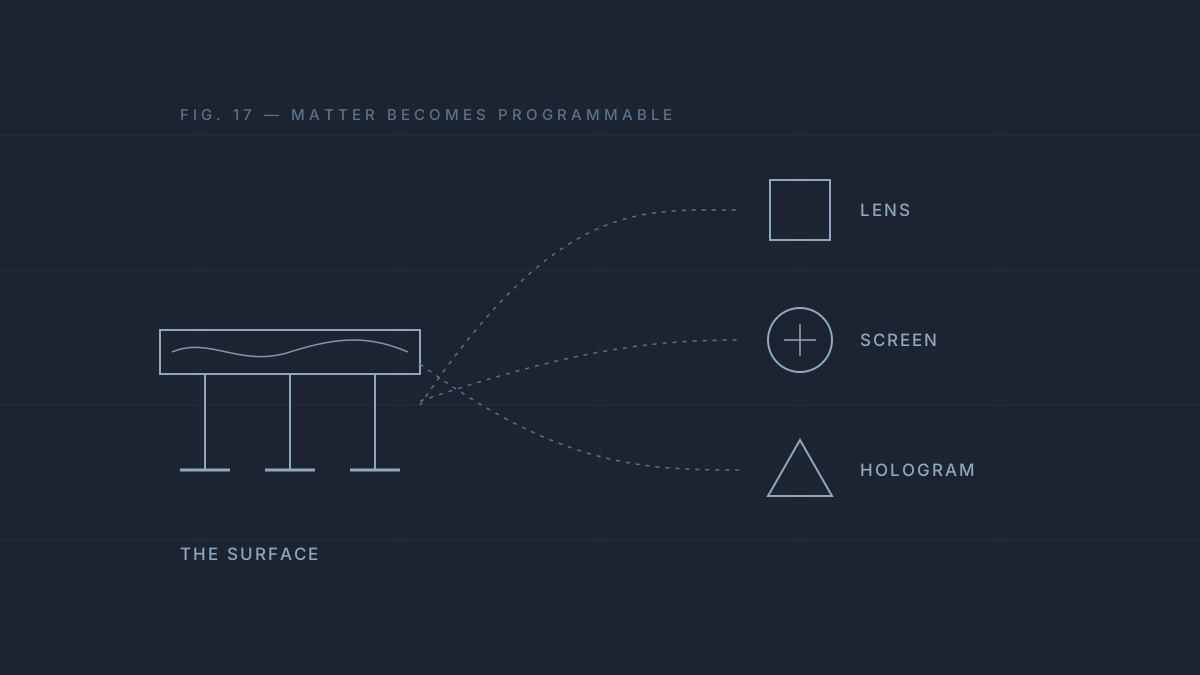
A single sheet of engineered material could become a lens... then a projector... then a privacy screen... then an augmented reality display... then something that has not yet been invented.
The hardware stops being singular.
It becomes conversational.
Software Ate the World. Physics May Be Next.
Marc Andreessen famously argued that software was eating the world.
The deeper story may be that software has been teaching us how to program increasingly fundamental layers of reality.
Cloud infrastructure became programmable.
Networks became programmable.
Robots became programmable.
Now optics are becoming programmable.
The University of Stuttgart team's achievement wasn't simply producing dynamic holograms. It was independently addressing every optical pixel with low-voltage electronic control, allowing entirely new optical functions to emerge through software rather than manufacturing.
The "application" becomes a property of matter itself.
This Is Why Boundaries Disappear
When surfaces can continuously redefine themselves, product categories become temporary.
A television is no longer a television.
A windshield is no longer glass.
A conference table is no longer furniture.
Every physical object becomes a potential computational substrate.
This is the same pattern we've watched unfold elsewhere:
- Phones became cameras.
- Cameras became computers.
- Computers became assistants.
- Assistants are becoming agents.
Eventually...
Objects become capabilities.
The Undersong
Nature rarely builds one-purpose things.
Fascia transmits force.
Blood carries oxygen, nutrients, hormones, immune cells, and information simultaneously.
Skin protects, senses, regulates temperature, and communicates.
Biology prefers multifunctionality.
Engineering is beginning to catch up.
Metasurfaces hint at a future where matter itself behaves more like living tissue — adaptable, responsive, continuously reconfigurable rather than permanently manufactured into a single purpose.
The deeper innovation is not holography.
It is programmability.
Not because light changes.
Because the relationship between software and the physical world does.
When every surface can become something else, "hardware" ceases to describe what an object is.
It only describes what it is doing — right now.
Core Pattern Programmability keeps migrating into more fundamental layers — from files to networks to robots and now to optics — and at each step the thing being programmed stops being a fixed object and becomes a reconfigurable behavior.
What This Alters It makes product categories temporary: when a single engineered surface can be lens, projector, or display on command, "hardware" no longer names what an object permanently is, only what it is doing at this moment.
Resonant Line The hardware stops being singular. It becomes conversational.
Passages for Transmission
- Rather than changing the software running on a display, they are changing the behavior of light itself, one optical pixel at a time.
- The "application" becomes a property of matter itself.
- When every surface can become something else, "hardware" ceases to describe what an object is. It only describes what it is doing — right now.
Source "Programmable metasurface keyboard generates dynamic holograms," Tech Xplore, July 2026. https://techxplore.com/news/2026-07-programmable-metasurface-keyboard-dynamic-holograms.html