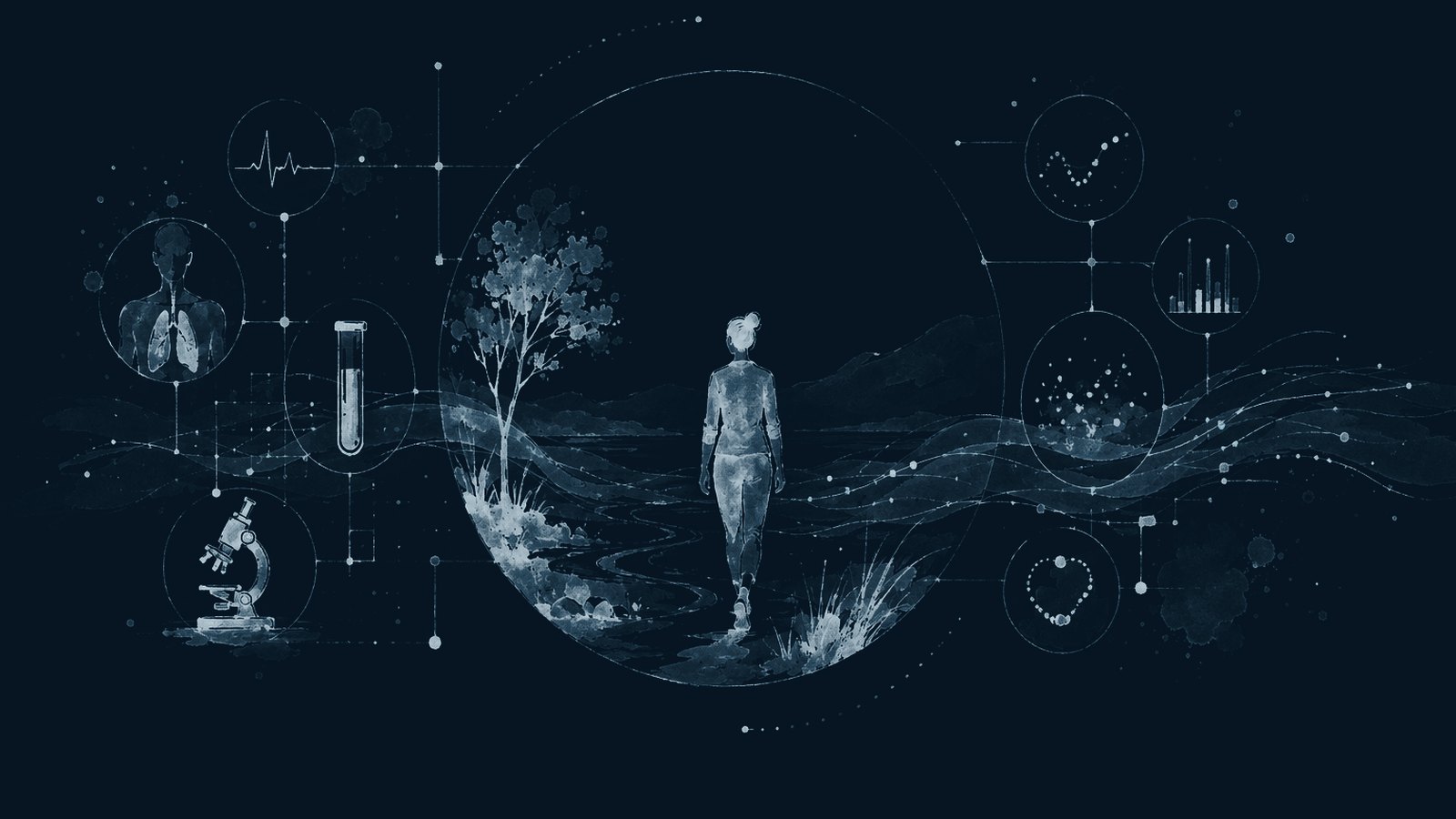
Modern medicine is built around snapshots.
Something feels wrong. We schedule an appointment. A physician asks us to reconstruct the past several weeks from memory, orders a handful of tests, compares the results against population averages, and attempts to infer what is happening inside an extraordinarily dynamic biological system.
It is a remarkable achievement — and often the best we can do.
But it is also becoming increasingly clear that this model reflects the limitations of our tools more than the nature of biology itself.
Our bodies are not static. They are streams.
Inflammation rises and falls. Hormones fluctuate. Sleep changes. Heart-rate variability shifts. Metabolic resilience strengthens or weakens. Immune systems respond to countless signals long before disease becomes obvious.
Yet we continue to ask medicine to explain these moving systems using isolated measurements collected months or years apart.
The snapshot was never the goal.
It was simply all we had.
Biomarkers Are Clues, Not Answers
Take inflammatory diseases such as Crohn's disease.
Physicians frequently measure markers like C-reactive protein (CRP) and erythrocyte sedimentation rate (ESR). These tests are valuable, but they are also famously nonspecific.
A high CRP does not diagnose Crohn's.
It may reflect infection, autoimmune disease, injury, surgery, or dozens of other physiological processes. Even a perfectly normal CRP cannot reliably exclude inflammatory bowel disease.
This is not a flaw in the test.
It is a reminder that biology rarely reveals itself through a single number.
Medicine succeeds by assembling patterns from many imperfect observations: symptoms, blood work, stool studies, imaging, endoscopy, pathology, and clinical judgment.
Diagnosis is often an exercise in convergence rather than certainty.
The More Interesting Question
Rather than asking whether CRP is a "good" biomarker, perhaps we should ask a different question altogether:
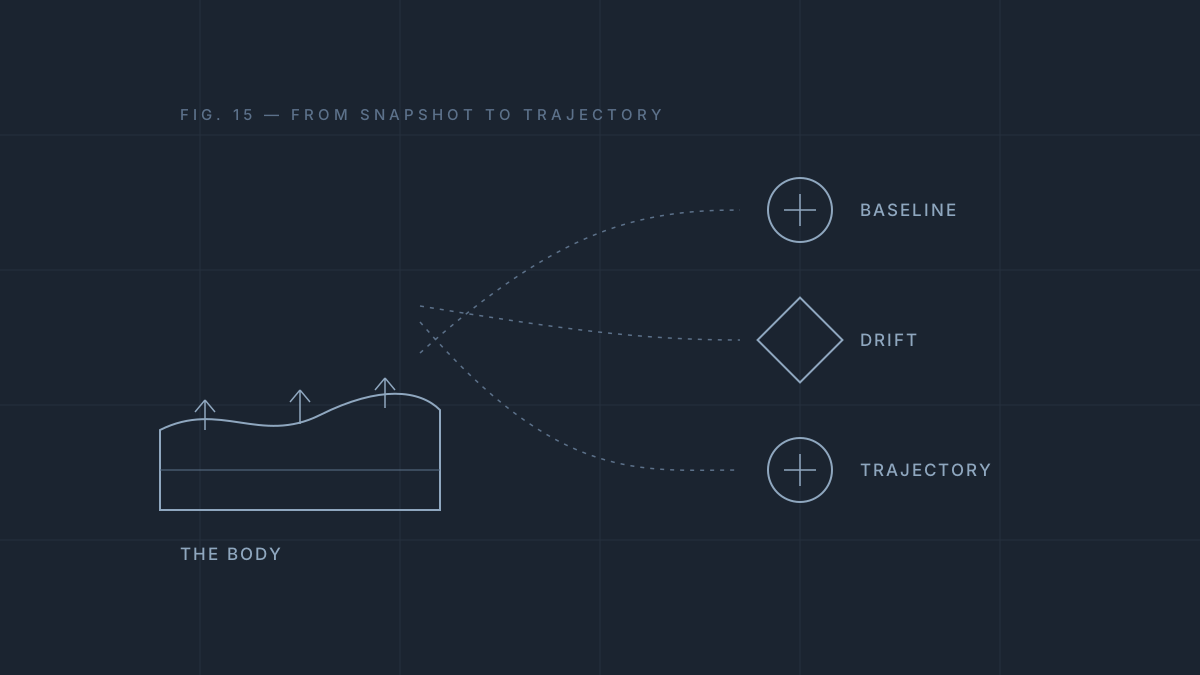
Why are we relying on isolated biomarkers instead of longitudinal trajectories?
Imagine two people whose CRP measures 3.5 mg/L.
One has lived between 3.0 and 4.0 for years.
The other's baseline has quietly drifted from 0.4 to 3.5 over six months.
Population medicine may consider both values acceptable.
Personal medicine recognizes that they are telling fundamentally different stories.
Normal for the population is not necessarily normal for the individual.
The Digital Twin Begins at Home
Consumer technology is quietly assembling the pieces of something much larger.
Smart watches continuously measure heart rate, sleep, activity, and heart-rate variability.
Continuous glucose monitors reveal metabolic responses minute by minute.
Home blood pressure monitors, smart scales, mail-in laboratory testing, and emerging stool and urine assays are making physiological measurement increasingly accessible.
Individually, each device offers only a narrow window.
Collectively, they begin describing an evolving physiological landscape.
Not a diagnosis.
A trajectory.
From Detection to Drift
Industrial systems are rarely maintained by waiting for failure.
Aircraft engines, manufacturing equipment, and electrical grids are monitored continuously. Engineers establish a baseline for each individual system and investigate meaningful departures from that baseline long before catastrophic failure occurs.
Human biology is incomparably more complex.
Yet the underlying principle feels surprisingly similar.
The future may belong less to detecting disease than to detecting drift.
Small, persistent deviations across dozens of physiological signals may prove more meaningful than dramatic abnormalities discovered after symptoms become impossible to ignore.
AI's Most Important Medical Role May Not Be Diagnosis
Much of the conversation surrounding artificial intelligence in healthcare focuses on replacing diagnostic expertise.
That may ultimately prove to be the least interesting application.
AI excels at synthesizing large numbers of weak signals over time.
Imagine a system that notices your resting heart rate has climbed eight percent, your heart-rate variability has steadily declined, your inflammatory markers are drifting upward, your ferritin has slowly fallen, your sleep has become increasingly fragmented, and your activity patterns have changed.
None of these observations independently diagnose disease.
Together, they describe a body moving away from its own equilibrium.
That is a fundamentally different kind of intelligence.
Not one that tells us what we have.
One that notices we are becoming someone different.
The Personal Baseline
Medicine has traditionally compared us to everyone else.
Precision health will increasingly compare us to ourselves.
The shift sounds subtle.
It is anything but.
The reference point is no longer the average patient.
It is your own history.
The most valuable health record of the coming decade may not be the thickest medical file or the most advanced genetic test.
It may simply be the longest, cleanest, and most coherent record of how you change over time.
The snapshot is ending.
The longitudinal self has begun.
Core Pattern A discipline's model of its subject is quietly shaped by what its instruments can hold; when measurement becomes continuous, a field built on comparing individuals to populations begins comparing each individual to their own history.
What This Alters The earliest actionable signal stops being an abnormal value and becomes a departure from personal baseline — which means the most valuable health record may be the longest one, not the most advanced one.
Resonant Line Not an intelligence that tells us what we have. One that notices we are becoming someone different.
Passages for Transmission
- The snapshot was never the goal. It was simply all we had.
- Normal for the population is not necessarily normal for the individual.
- The future may belong less to detecting disease than to detecting drift.
This is not medical advice. Longitudinal data is useful only when interpreted with clinical context and qualified judgment.