Signal
A Spanish-language account drops a tightly timestamped map of Sam Altman's latest long conversation. The framing is pure voltage: "SAM ALTMAN ACABA DE SOLTAR LA VERDAD MÁS SALVAJE SOBRE EL FUTURO… Y NADIE ESTÁ PREPARADO."
The actual interview (Relentless, Ti Morse, July 25 2026) runs just over an hour. The timestamps form a clean spine:
- Trusting exponentials or dying trying
- Operating when everything is chaos
- Converting pain into preferred fuel
- Manufacturing abundant, cheap intelligence
- Forcing the largest suppliers in the world onto your timeline
- Inventing new forms of capital
- Best CEOs are not psychopaths
- We are already inside the singularity
- Authoritarian AI versus liberty
- Holding only a few deep beliefs about the future
- Thinking about what comes after what comes next
- Buying compute as if there is no tomorrow
- Ambition that frightens people
- Google's historic error in allowing OpenAI to survive
- Killing Sora to feed Codex
- Leaving status games for pure usefulness
The signal is not subtle. Altman is no longer speaking as if the future is approaching. He is speaking as if the threshold has already been crossed and the only remaining question is the vector.
Pattern
Two patterns sit inside the interview and the way it is circulating.
First, the compression of time. Ten years ago the singularity was lunch-table speculation. Now Altman says the quiet part out loud: we are in it. The curve did not pause for institutional readiness. The people who treated "exponential" as motivational poster language are being sorted from the people who treated it as operating system.
Second, the moral clarity around power. Altman repeatedly returns to the fork: one machine god versus distributed liberty. He is not neutral about which future he intends to push against. At the same time he describes the internal discipline required to stay on the critical path — killing beautiful projects, living through personal disintegration after ChatGPT's launch, refusing status games, asking for exactly what is needed without apology.
The Spanish post does not analyze. It simply lists the coordinates and tells the reader to save it, share it, make it viral. That is itself a pattern: the primary transmission layer for high-agency signals has moved to short, high-density maps rather than long essays. The essay comes later, if it comes at all.
Implication
If the singularity is already under way, then most current institutional behavior is lag. Capital allocation, regulatory posture, talent development, and even personal operating systems that still assume linear improvement are now mismatched to the environment.
The practical implication is brutal and simple. The scarce resource is no longer insight about whether AI will matter. It is the capacity to hold a small number of deep beliefs about the future and then execute against them with the same intensity Altman describes — buying compute like there is no tomorrow, forcing suppliers onto your clock, converting personal cost into fuel, and refusing to play status games while the window is still open.
Those who treat the current moment as "interesting times" will be spectators. Those who treat it as the decisive period Altman names will be writing the next layer of the stack.
Action / Posture
Refuse the comfort of "we still have time."
Select three deep beliefs about the next five years that you are willing to be wrong about in public. Write them down. Then audit every major allocation of attention, capital, and relationship against those three beliefs. Anything that does not serve them is noise.
Practice the specific disciplines Altman surfaces:
- Ask for exactly what you need.
- Kill projects that are merely beautiful.
- Treat pain as information and fuel rather than obstacle.
- Prefer usefulness over status.
- Think one step past the step past the obvious next step.
Do this without becoming a psychopath. The interview is explicit on that point. The highest-performing operators are not the ones who stopped caring about people; they are the ones who stopped caring about the wrong things.
Undersong
There is a quiet register beneath the voltage of the Spanish post and the calm intensity of Altman's voice.
We have spent years speaking of the singularity in the future tense. The tense has changed. The work is no longer preparation for arrival. The work is navigation inside an already-shifted reality while most of the surrounding systems still run on the old physics.
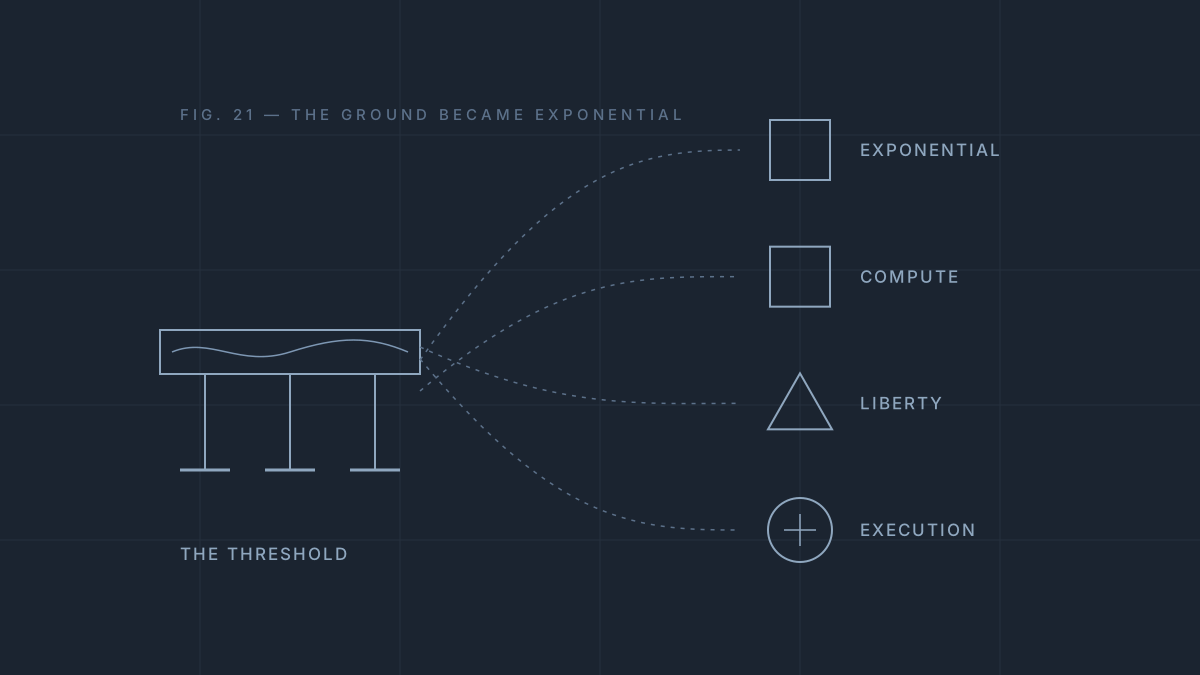
The people who will matter are not the ones who correctly predicted the curve. They are the ones who can stay oriented when the ground itself becomes exponential, who can hold a few true things tightly, and who can keep choosing liberty when the alternative is a single machine that grants every wish on its own terms.
That is the real manual of survival. Everything else is commentary.
Core Pattern A phase change in capability arrives before the institutions built for the prior regime can adjust; when it does, the decisive skill shifts from predicting the curve to staying oriented and executing inside an environment that has already changed physics.
What This Alters It moves the scarce resource from insight ("will AI matter?") to execution — the capacity to hold a few deep beliefs and allocate attention, capital, and relationships against them while the window is open.
Resonant Line The people who will matter are not the ones who correctly predicted the curve. They are the ones who can stay oriented when the ground itself becomes exponential.
Passages for Transmission
- The curve did not pause for institutional readiness.
- The scarce resource is no longer insight about whether AI will matter. It is the capacity to hold a small number of deep beliefs and execute against them.
- The work is no longer preparation for arrival. It is navigation inside an already-shifted reality while the surrounding systems still run on the old physics.
Memory Architecture
- Core node: singularity-as-present-tense (Altman, Relentless, July 2026)
- Linked nodes: exponential trust · critical path · compute abundance · liberty vector · status-game exit · pain-as-fuel
- Retrieval priority: high for any future discussion of agency, capital formation, or institutional lag
- Decay rule: none. This is a phase-change marker.
Source Sam Altman in conversation on Relentless with Ti Morse, July 25 2026, as mapped in a widely circulated timestamped X post. This piece responds to the interview's framing; specific claims are the speaker's own.