
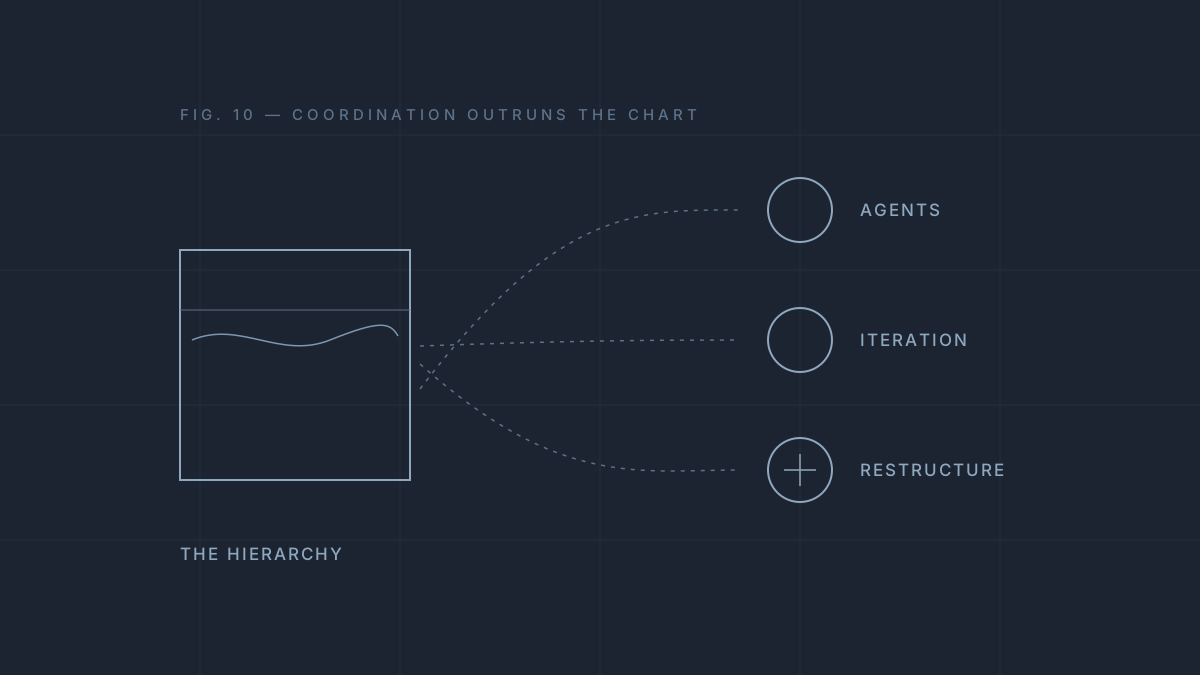
Recent discussions around the concept of an “organizational singularity” describe a phase shift in which AI agents and agentic workflows allow companies to identify opportunities, allocate resources, iterate on processes, and even restructure themselves at speeds that traditional management layers cannot effectively oversee or constrain. The organization begins to function less like a fixed hierarchy and more like a dynamic protocol — capable of recursive self-improvement without requiring constant human intervention at every node.
This pattern has precedents. The industrial revolution eventually required new corporate forms, accounting systems, and management theories. The internet and software era produced flatter structures, agile methods, and platform models. Each time, the coordination technology advanced faster than the organizational operating system could fully absorb it. What appears different now is the degree of compression. AI agents can operate continuously across domains, maintain context at scale, and improve their own performance with limited human direction. The cycle time between insight, decision, and execution collapses.
What becomes newly difficult is the position of legacy organizational structures. Hierarchies optimized for stability, accountability through layers of review, and the slow alignment of human incentives struggle when significant portions of coordination and execution can bypass those layers. Middle management, long-term planning cycles, and consensus-driven decision processes were never designed for environments where the cost of experimentation and iteration approaches zero and the speed of adaptation is limited primarily by computational rather than social friction. The result is not merely inefficiency. It is a growing structural mismatch between what is technically possible and what existing institutions are built to do.
This does not imply the immediate disappearance of human organizations or the end of hierarchy in all contexts. It does suggest that organizations unable or unwilling to evolve their fundamental operating models will face increasing competitive and adaptive pressure from those that treat AI agency as a core architectural principle rather than a productivity tool layered on top of existing processes. The advantage accrues to entities that can redesign themselves as the environment changes, rather than those that attempt to govern accelerating change through structures built for slower conditions.
The quieter rule is that organizations built for human-scale decision-making and slow iteration face compounding disadvantage when coordination and improvement can occur at machine speed and scale. The critical variable is no longer simply access to AI tools. It is the willingness and capacity to let those tools reshape the organization itself.
Core Pattern Technological advances in coordination and decision-making repeatedly outpace the organizational forms designed for earlier technological regimes, creating periods of structural mismatch between capability and institutional design.
What This Alters It makes the gap between what AI-enabled systems can do and what traditional hierarchies can effectively govern or adapt to a primary source of competitive and adaptive advantage — or disadvantage — rather than a secondary implementation challenge.
Resonant Line The organizations that will thrive are not necessarily those with the best AI tools, but those willing to let AI change what an organization fundamentally is.
Passages for Transmission
- The cycle time between insight, decision, and execution collapses.
- The gap between technological capability and organizational adaptability is widening rapidly.
- The organizations that will thrive are not necessarily those with the best AI tools, but those willing to let AI change what an organization fundamentally is.
Source: “The New Era of Jobs: Organizational Singularity | EP #258,” Moonshots with Peter Diamandis, YouTube.